Digital PR needs an editor. HARO needs a reporter's request. OPA needs neither: a direct trade with whoever already has the audience you want.
Gert Mellak, an AI SEO consultant and the founder of SEOLeverage, opened a recent Search Engine Land piece with a thought experiment: imagine Google disappears tomorrow. You'd still have a product, still need to reach your audience, and you'd have to find that audience where it already spends time instead of publishing content and waiting for rankings to bring people in. One of the tactics he singles out for that world, which turns out to work just as well in this one, is what he calls other people's audiences, or OPA: finding whoever already has the audience you want and making a direct trade for access to it.
What OPA actually is
Most link building advice treats audience growth as a one-way problem: how do you grow your own list, your own following, your own traffic. OPA starts from a different question. Someone else, almost certainly, already has the audience you're trying to reach. They might sell a related product, solve a different problem for the same customer, or run a newsletter, private community, membership site, or podcast your audience already trusts.
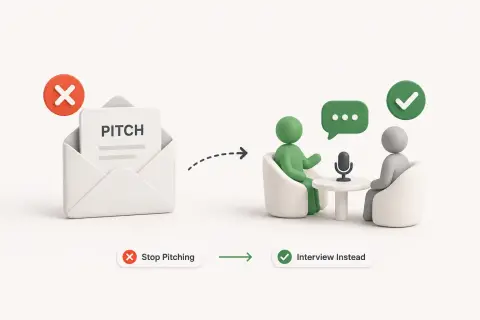
Mellak's suggested opening is blunt enough to reuse almost verbatim: "Hey, I have this offer or resource. It could be useful for your audience. I can offer a kickback, create free training, or give you exposure to my network. Would you be open to including this in your next newsletter or exploring another way for us to get it in front of your audience?" The pitch is a value exchange, offered as one from the first line, not a story angle and not a favor.
He backs it with his own case study. Early in his agency's history, he contributed SEO tutorial videos to private membership sites, at no cost, in exchange for exposure to a warm, pre-qualified audience. The membership sites got free training content for their members. He got in front of people who already trusted the platform hosting him, and because the introduction came through that trusted source, some of that trust transferred to his own brand. That transfer, not the link itself, is the actual mechanism doing the work.
Where this fits in a broader distribution strategy
Mellak frames OPA as one piece of what he calls the search everywhere optimization pyramid, a five-layer model that runs, in order: audience research, monitoring and alerts, industry publications and third-party presence, distribution, and only then owned content. His observation is that most companies start at the last layer, cranking out content for their own site and hoping search rewards it, when the more durable approach builds the first four layers first. OPA lives specifically in the third and fourth layers: borrowing trust from third-party environments, then using that borrowed platform to distribute.
That ordering matters for why OPA outperforms cold outreach that leads with a link ask. A pitch to a newsletter operator or community owner that opens with "will you link to me" is a request for a favor. A pitch that opens with a specific offer, free training, a kickback, reciprocal promotion, cross-exposure to your own list, is a trade two parties can both say yes to without anyone doing the other a solid.
Why this isn't digital PR and isn't post-HARO outreach either
It's worth being precise about the mechanism here, because OPA gets lumped in with two tactics this blog has already covered that work differently.
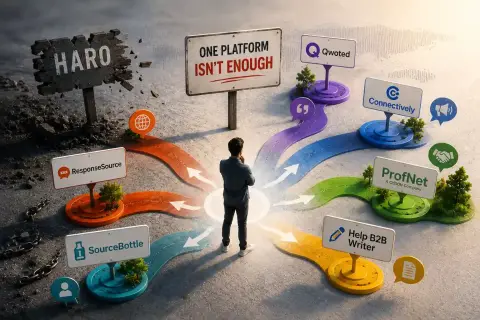
Digital PR runs through a journalist or publication as the gatekeeper. The pitch has to clear a newsworthiness bar, the coverage decision sits with an editor, and the resulting link is earned inside someone else's editorial judgment about what their readers need to know today. Journalist-request platforms work similarly but reactively: a reporter posts a specific need, and sources compete to be the one quoted, with no ongoing relationship required.
OPA has neither gatekeeper. There's no editorial bar to clear and no reporter waiting with an open request. The person on the other end is an audience owner, not a journalist, and the ask is closer to "let me put something useful in front of your people, here's what's in it for you" than to "cover my story." That also means OPA doesn't compete for a slot the way a HARO-style pitch does against dozens of other sources; it's a direct, targeted approach to one specific person who controls one specific audience, and the outcome depends on the quality of that one relationship rather than beating out other pitches.
Who's actually worth pitching
The candidates aren't competitors. They're businesses and creators serving the same customer profile from an adjacent angle: a complementary product's newsletter, a niche community or membership site your buyers already belong to, a podcast your audience already listens to, or an industry publication with its own loyal readership. The filter is the same one that makes any of this worth the effort: does this platform already hold the trust of people who'd plausibly become your customers, and does it hold enough of an audience that access to it is worth something concrete in return.
The offer side matters as much as the target list. A generic "would love to collaborate" message asks the other party to invent the value exchange themselves, which is exactly the kind of vague outreach that gets ignored. A specific offer, free training content built for their exact audience, a revenue-share kickback on anything that converts, or genuine cross-promotion to a list of your own, gives them something to evaluate and say yes to on the spot.
Consistency is what makes the trust actually transfer
Mellak makes a second point worth carrying into how OPA gets executed: platforms and AI systems increasingly rely on consistent information about a brand across every place it shows up, from its own site and social profiles to podcast interviews and third-party mentions. Only consistent information sticks, in his words. That matters directly for OPA. A guest contribution to someone else's newsletter or membership site is only doing brand-building work if the framing of who you are and what you do matches what shows up everywhere else people encounter your name. A one-off appearance with an inconsistent pitch is a wasted introduction; a consistent one compounds every time it's repeated across a new audience.
A vetted, categorized directory listing is a smaller version of the same idea: it's one more place where consistent, accurate information about a business shows up in front of people who are already looking for exactly that kind of business, without needing an editor's approval or a reporter's open request first.