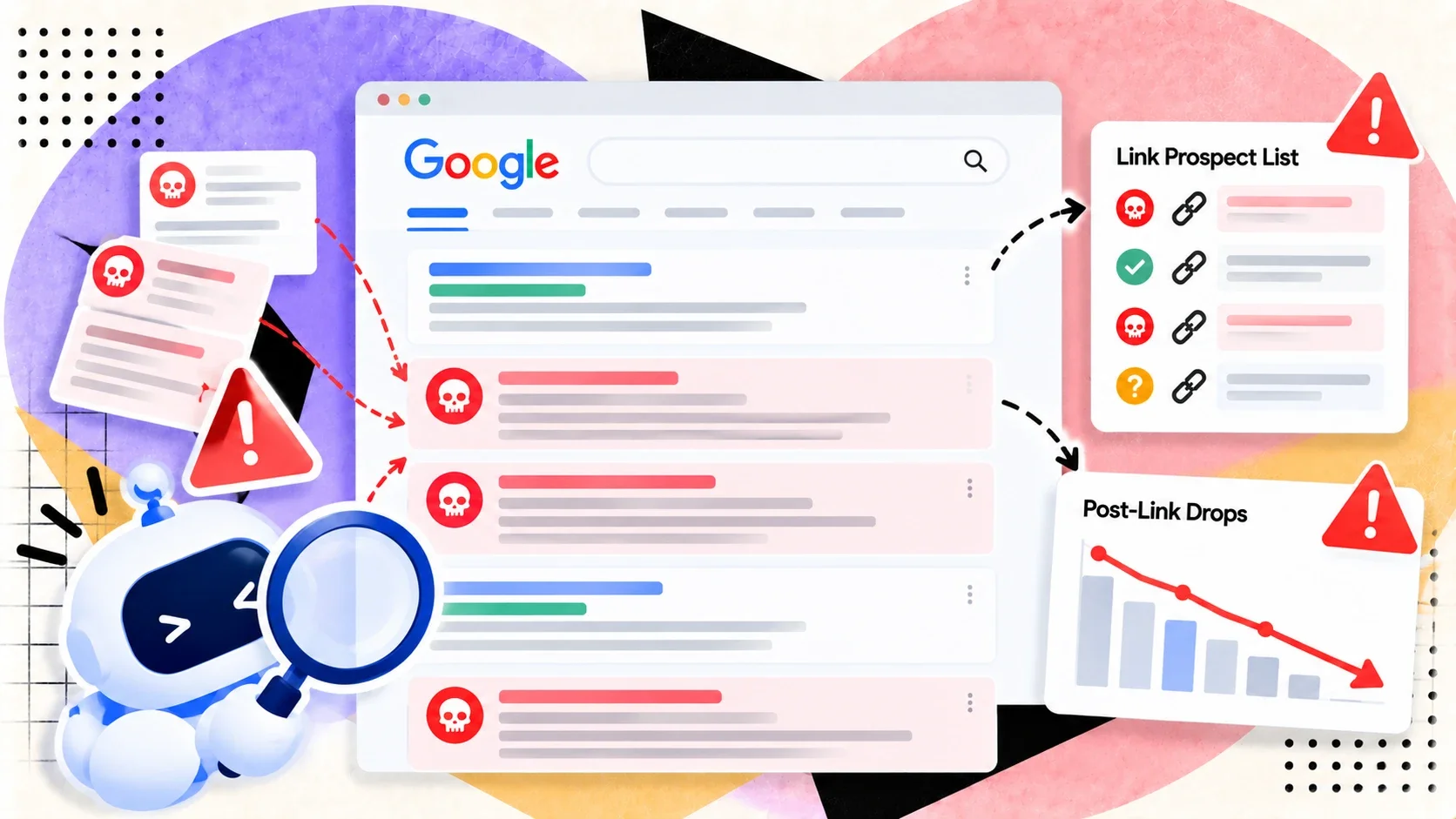
Nozzle and Keyword.com found Google serving rank trackers wrong results pages. Here is what that does to link prospect lists and drops after link building.
Your rank tracker says the page you just built links to fell out of the top 10 overnight. Before you blame the links, check whether the page you were measuring was the real results page at all.
Two rank-data companies have now published numbers on what they call poisoned SERPs: complete, normal-looking Google results pages that are missing most of the sites that usually rank. If you build links, the damage runs in two directions. It can fake a ranking drop after a campaign, and it can fill a prospect list with pages that were never ranking for the search.
What the studies found
Nozzle, a SERP data provider, published its study on October 10 with data through October 9. It collected 27.5 million SERPs since September 13, judged 17.8 million of them, and found 8.0% were poisoned, against 0.17% before. On the worst days, September 27 to 29, roughly a quarter of SERPs were.
Nozzle defines a poisoned SERP as one where fewer than half of the keyword's usual sites appear anywhere on it, and where they come back on a later check. The page has no error and no captcha. On those pages the organic results kept 20.7% of the previous SERP's sites, against 88.5% normally. For keywords where a tracked project's own site was among the usual sites, that site was outside the top 10 on 58.6% of poisoned SERPs, against 2.7% before.
Keyword.com, a rank tracker, published its own data on October 16, using a definition adapted from Nozzle's. It found 13.1% of its SERPs poisoned from September 13 to October 14, against 0.3% in August, with a peak of 34% on September 30. Tracked domains that normally ranked in the top 10 were outside it on 72% of poisoned SERPs, against 3.5% normally.
The two figures differ because the samples and baseline periods differ, and Keyword.com says some of its details, such as how often AI Overviews appear, do not match Nozzle's and that it has no explanation. Both companies sell rank or SERP data, and both say their numbers come from automated checks, so they cannot show what a real searcher saw.
What caused it is not settled
Nozzle's reading is that this is Google's response to AI scraping, with rank trackers caught in it. Search Engine Journal reported that as Nozzle's claim and framed it as something Google may be doing. None of the three pages I read includes a statement from Google, so treat the cause as unconfirmed even though the pattern in the data is consistent across both sources.
Two ways it hits link building
A drop after you build links. The signature of a poisoned SERP is a sudden, total reshuffle that reverses quickly. Nozzle found 77.9% of poisoned SERPs had their usual sites back within three days, and 80% of poisoned spells lasted a single check. Keyword.com found 78% back within three days. A real ranking change stays. If your tracker shows a page falling out of the top 10 the day after links went live, wait for the next checks before reading anything into it. Our post on rankings dropping after you build backlinks covers the real mechanisms, and our look at the first-of-the-month volatility pattern shows how easy it is to see a pattern in noisy data.
A prospect list built from results pages. This part is our inference, not something either study measured. Link prospecting often starts with scraping or exporting the results for a search: sites that rank for a topic, resource pages, roundups. During the poisoned window those pages could contain the wrong sites. Nozzle's own example is the search "white label local seo," where the usual vendors were replaced by a WordPress tool, a steakhouse, a county health directory and a government site. Social sites and forums also took more of the top 10: Nozzle saw Reddit in the top 10 on 28.8% of poisoned SERPs against 20.8% on the same keywords' other SERPs, and Keyword.com saw 28% against 13%. A list pulled on a bad day would be full of pages that are neither competitors nor good targets.
The same logic applies to a competitor gap analysis that relies on which domains currently rank for a set of keywords. If you want a refresher on how those are built, see our post on backlink gap analysis.
What to do about it
Check any export you pulled between early September and mid-October. Compare the list of ranking sites with an older export for the same search. If most of the usual names are missing and a few forums and unrelated sites are in their place, discard that pull and re-run it. Rebuild competitor sets from a date before the window rather than from the middle of it.
For drops, open Search Console for the affected query and match the country and device. Keyword.com advises matching the country and device. If impressions and clicks held steady while the tracker showed a collapse, the problem is in the collected page, which is the same test Nozzle suggests. Then wait two or three days before deciding the links did anything.
Keep dated exports of every prospect list and every rank check from now on. They are the only way to tell, later, whether a strange result was the data or the site.
Finally, confirm the links themselves independently of rank data. SerpCrest's bulk DoFollow checker tests whether a link is live, followed and indexed, so you can tell a rank-data problem from a lost link.
The short version: until the dust settles, treat any single day of Google results data as a lead, not a result, and make decisions on lists and drops only after a second check confirms them.