Mutual links are common, but excessive swaps are link spam. What Google says, why no safe number exists, how ABC swaps fit, and how to find your mutual links.
Linking to a site that links to you is common, and Google's spam policy does not name it. What the policy names is excessive link exchanges and pages made only to swap links. The line between the two is not a number of links. It is why the link exists. Here is what Google's policy says, why there is no safe number, what the data shows about how common mutual links are, how three-way swaps fit in, and how to find the mutual links you already have.
What Google's policy says
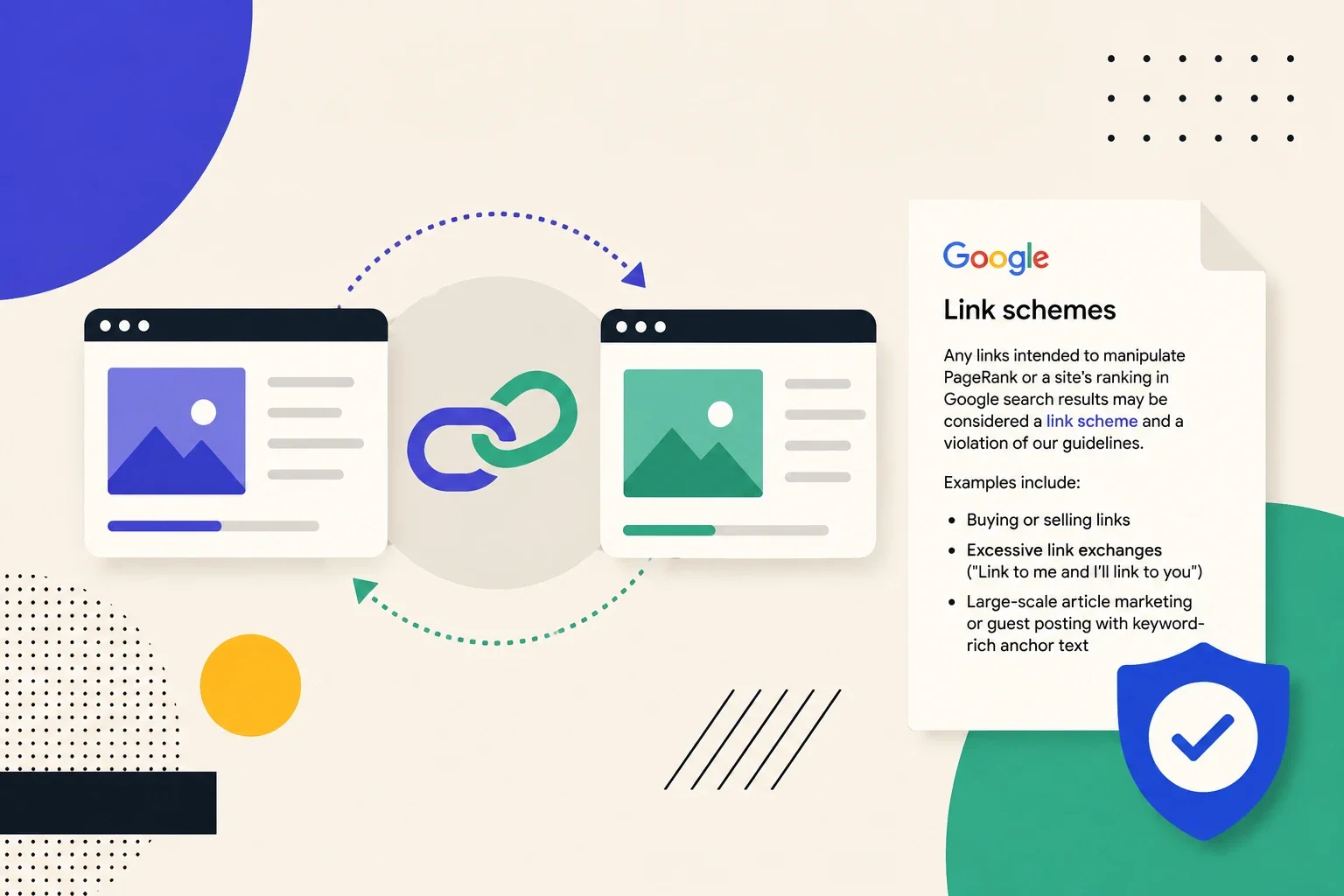
Google's spam policies define link spam as "the practice of creating links to or from a site primarily for the purpose of manipulating search rankings." The examples include "Excessive link exchanges" and, in the same item, "partner pages exclusively for the sake of cross-linking". Google's own shorthand for the pattern is in brackets: "Link to me and I'll link to you".
Two words carry the weight: excessive and exclusively. The policy does not forbid two sites from linking to each other. It names exchanges done at volume and pages that exist only to swap links. Google gives no number at which exchanges become excessive, so do not trust anyone who quotes one.
The same list also includes "Exchanging goods or services for links". A swap that comes with a free product or a service on the side is a paid link, which is a separate problem.
Is there a safe number of exchanges?
No. When John Mueller of Google was asked how much link exchanging is permissible, his answer, as reported by Search Engine Journal, did not include a number. He said an exchange where both sides are "kind of like you link to me and therefore I will link back to you" is against Google's guidelines, and that its algorithms try to ignore those links. He added that a manual action is possible if such links are the majority of the links to a site. Asked whether it helps if the sites are related, he said it does not matter if the link is topically relevant when you do it systematically.
So a small number of deliberate swaps is still against the guidelines. By Mueller's account, Google tries to ignore those links, and a manual action becomes possible if they make up most of your links. The Ahrefs figures below describe how much overlap is common among sites with search traffic, not a safe limit for arranged swaps.
How common mutual links are
At the time of its study, mutual links showed up across sites that got plenty of search traffic. Ahrefs studied reciprocal links across 140,592 domains with 10k or more estimated monthly visits from Google, counting only followed links in both directions, and found that 73.6% of them had at least one. In a second sample of top 10 results, 43.7% of the 112,440 top-ranking pages it studied had some reciprocal links. On its own blog, Ahrefs found "19.25% of the domains we link to also link to us."
Ahrefs is clear about the limits. It says the study does not prove reciprocal linking is safe, because it only looked at sites with search traffic, so "any penalized websites were likely excluded from the start." The data shows that some overlap is ordinary. It does not show that deliberate swaps help.
Three exchanges, checked against the policy
Run any mutual link through these four questions. They are our own way of applying the policy wording, not a Google test.
- Would the link exist if rankings did not matter?
- Would your readers find the other site useful?
- Is it one link with a reason, or the same deal repeated with many sites?
- Did anything else change hands?
An integration page. A scheduling app lists the calendar tools it connects to, and one of those tools lists the app on its integrations page. Each link tells users something true about the product. It passes all four questions.
Two local businesses. A wedding photographer links to a florist they work with often, and the florist links back from a page of recommended vendors. Customers overlap, the recommendation is real, and nothing was paid. It passes, as long as the vendors page lists people they work with rather than anyone who asked.
A swap offer by email. A site you have never heard of, on an unrelated topic, offers a link from its partners page if you add one back, and mentions it runs the same deal with dozens of sites. It fails the second and third questions, and the partners page matches Google's "partner pages exclusively for the sake of cross-linking" almost word for word. Decline it.
Three-way and ABC exchanges
Some offers add a third site to hide the trade. In a three-way exchange, as Search Engine Journal describes it, one site owner arranges a link to you from a second site, and you link to their main site in return. The purpose, SEJ says, is to make the links look one-way instead of reciprocal.
Google's definition of link spam is about purpose: links created "primarily for the purpose of manipulating search rankings". The definition says nothing about whether the return link comes back directly or through another site. Run an ABC offer through the four questions above. It fails the first one by design, since SEJ says its purpose is to trick Google, so decline it.
Ahrefs' own view, from the same study, points the same way. Tim Soulo calls linking out to relevant resources and building relationships a good strategy, and asks anyone sending link-swap outreach emails to "please stop".
How to find the mutual links you already have
Ahrefs measured overlap by comparing the sites a domain links out to with the sites that link to it. You can do the same for your own site:
- In Google Search Console, open the Links report, go to External links, then Top linking sites, and export the list. Google notes the report is a sample, not every link, and it does not say which links are nofollow.
- Make a list of the domains your own site links out to, for example from a crawl of your own site or a backlink tool's outgoing links report.
- Put both lists in a spreadsheet and match the domains. Each match is a likely mutual link at the domain level. Google notes the report can include links that have since been removed.
- Run each match through the four questions above. Look harder at any match on a partners or links page, or one you remember agreeing to.
If you already have swapped links
If you joined an exchange scheme in the past, look at the pages involved. Remove links from any page that exists only to trade links, and keep the mutual links that would make sense to a reader. For links pointing at you that you never asked for, Google's disavow help page says "most sites will not need to use this tool", so do not reach for it by default.
For another link type that people ask about, see our post on blog commenting for SEO. For the pace question, see how many backlinks per month is safe.