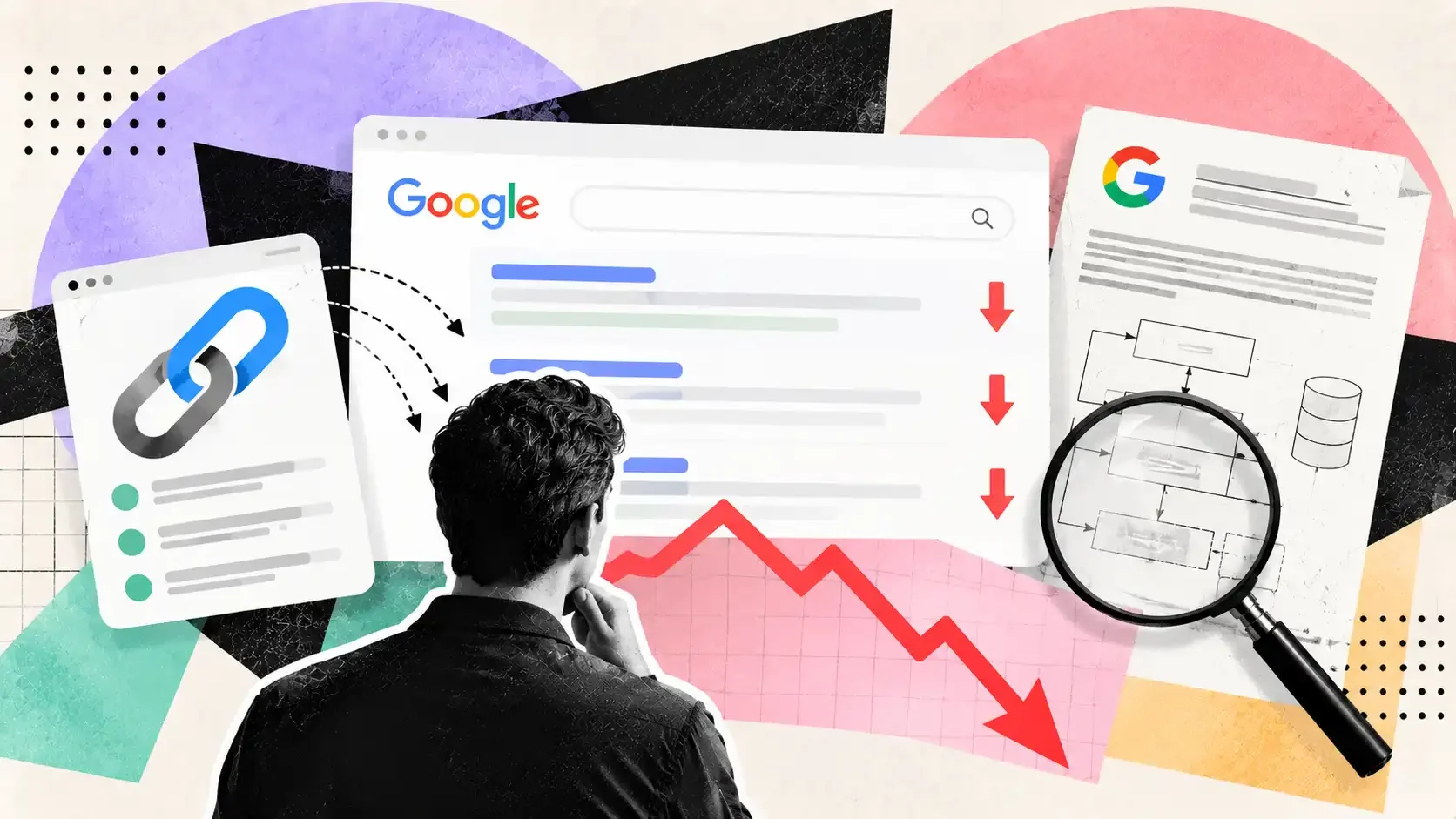
A Google patent describes rankings that dip after new links, then watches how site owners react. What it says, what it doesn't, and what to do in a dip.
You land a batch of good links. A week later the page has slipped from 15 to 22. The instinct is to do something: pull the links, rewrite the page, buy more to push through.
A Google patent describes a system built to catch exactly that instinct. It's US8244722B1, titled simply "Ranking documents", credited to early Google engineer Ross Koningstein and granted in August 2012. A new YouTube breakdown by Justin Davis of the Link Builders channel, published September 28, 2026, walks through it. The video's reading is mostly right, but it's worth going to the patent text yourself, because the useful part is narrower than the scary version.
What the patent describes
The abstract is short. A system works out a document's current rank and a new rank, then, during the move from one to the other, changes a "transition rank" using "a rank transition function that varies the transition rank over time without any change in ranking factors associated with the document."
Plain version: Google calculates where your page should land, but what you see in the results during the move can follow a different path. That path can shift on days when you changed nothing.
The patent names its target directly: "rank-modifying spammers," whose techniques include "keyword stuffing, invisible text, tiny text, page redirects, META tags stuffing, and link-based manipulation." The first five are mostly history. The sixth is link building.
The dip is described on purpose
Among the possible transition paths, the patent describes one it calls an "initially-inverse response transition function." After a change that should help, the rank first moves the wrong way, then turns around and heads to the new position. Other options in the patent include a straight delay and a slow, damped glide.
The examples in the patent's figures use day counts of "approximately 20 days" and "approximately 70 days." The Link Builders video reads these as about 20 days of decline followed by arrival at the target around day 70. Treat those as illustrations from the drawings, not a timetable Google has published.
Your reaction is the signal
Most summaries stop at the dip. The patent goes further: the transition functions are also meant to provoke a reaction. It says "unexpected results are bound to elicit a response from a spammer, particularly if their client is upset with the results." After a drop, the spammer "may remove the changes." After a delay, they "may perform additional changes." Either way, "these further spammer-initiated changes may assist in identifying signs of rank-modifying spamming." Elsewhere it puts it more bluntly: "correlation over time can be used as an automated indicator of rank-modifying spam."
And if a document is judged to be spammed, "the document, site, domain, and/or contributing links may be designated as spam."
So the risky behavior goes beyond building links. It's building them, seeing a strange move, and reacting in a tight loop: links in, rank wobbles, links out, rank wobbles, more links. A business owner who earns links and goes back to work never creates that pattern.
What the patent doesn't prove
There are three caveats, and they matter as much as the patent does.
A patent isn't proof of use. Google files plenty of ideas it never ships, or ships in a very different form. This one shows how Google engineers thought about spam feedback loops, not what runs in Search today.
It has lapsed. Google Patents lists the status as "Expired - Fee Related," meaning maintenance fees weren't paid. That's a legal detail and tells you nothing either way about the algorithm.
Most dips have duller explanations. Google's own guide to debugging traffic drops lists algorithmic updates, technical issues, security issues, spam issues, seasonality and site moves, and notes that "small fluctuations in position can happen at any time (including moving back up in position, without you needing to do anything)." Recrawl timing and competitors shipping better pages explain a lot of week-two wobbles too.
One more detail worth knowing: the Link Builders video comes from a channel that sells link building, and the patent's message (be patient, don't panic) also happens to be the message a vendor wants clients to hear mid-campaign. The patent text backs up their reading. Just keep the source in mind.
What to do during a dip
Check the boring causes first. Look at Search Console for a manual action or security issue, and check the Google Search Status Dashboard for an update overlapping your dates. Spam updates have come fast this year; we counted the shrinking gaps in our post on four spam updates in seven months.
If nothing explains it, change nothing for a while. No link removals, no rewrite, no emergency link buy. The patent's examples run to about ten weeks. You don't need to wait that exact window, but deciding within days is how you produce the pattern it describes.
Keep a steady pace. Bursts followed by silence followed by bursts look like someone chasing rankings. Steady acquisition looks like a business. We covered what Google has said about pace in how many backlinks per month is safe.
Watch weeks, not days. Daily rank checks make reacting more likely. Compare four-week averages before and after the links went live.
Tell clients before the campaign starts. If you've warned them, a dip is just something to point at in the monthly report. If you haven't, it turns into a request to "do something," which is the wrong move here.
Where this differs from what's already on this blog
Why Google traffic keeps turning on and off dealt with repeated collapses and full recoveries in reach, without anyone changing anything. This post is about one specific trigger: a drop that follows your own link building, and why your response to it matters.
The short version
If your rankings fell right after you built good links, the worst thing you can do is react fast and repeatedly. Rule out manual actions, updates and technical problems, then give the links time. And if the links you built were the kind you'd panic about, that's the real issue. Links from relevant, editorially reviewed sources, like the niche directories SerpCrest tracks, are the kind you can leave alone while they settle.