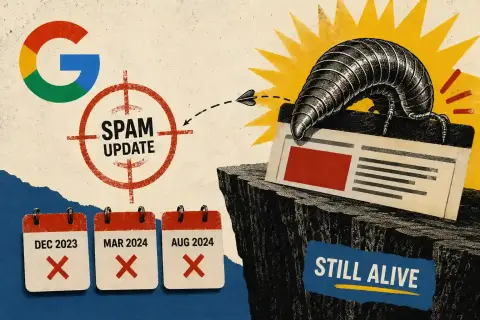
Google's 2026 spam updates arrived 92, 55 and 37 days apart. Recovery takes months. Here is what the shrinking gap means for a site cleaning up.
Google released its fourth spam update of 2026 on September 24. Laid next to the first three, the dates make a pattern that the announcements themselves never mention. The March update started on the 24th and finished a day later. The June update ran from the 24th to the 26th. The August update ran from the 18th to the 21st. The September update, announced by Google as one that "may take up to two weeks to complete," is the first of the year with a rollout measured in weeks.
Count the days between starts and the gaps shrink each time: 92 days from March 24 to June 24, 55 days from June 24 to August 18, and 37 days from August 18 to September 24. That arithmetic is easy to check from Search Engine Roundtable's list of documented spam updates, which gives the start and completion dates for each.
What Google says recovery takes
Google's spam update documentation, quoted in full by Search Engine Roundtable, says that making changes "may help a site improve if our automated systems learn over a period of months that the site complies with our spam policies." Search Engine Roundtable's summary of its conversation with Google adds that periodic refreshes of the update can follow and that recovery can take many months.
Put those two facts together. A site hit in March and cleaned up that week would have needed to stay clean for several months before Google's systems could be expected to notice. In that time three more spam updates arrived. Google hasn't said that a new update restarts anyone's clock, and nothing in the documentation suggests it does. What the dates show is narrower: the interval between enforcement events is now shorter than the "period of months" Google describes for a site to prove itself, so a site that is mid-recovery is being evaluated through updates it can't wait out.
The September update is not behaving like the others
The first three updates were short. Search Engine Roundtable checked with Google's John Mueller that the two-week estimate wasn't a typo, and he confirmed this one was likely to take longer than the earlier ones. The pattern in the data so far matches that. Barry Schwartz reported that the first wave of sites seemed to be hit on September 25 to 27, that things cooled, and that a second wave appeared around September 30 and October 1. His read is that a two-week rollout could produce several separate bursts of impact on different days.
Glenn Gabe, who tracks affected sites, reported hearing from multiple site owners who saw a large drop on September 30 specifically. Forum posters in the same thread described Discover and News traffic disappearing and returning. Those are anecdotes from people who chose to post about a drop, so they show that effects occurred, not how common they were.
For anyone doing a post-mortem, the practical consequence is that a single before-and-after comparison no longer works. If a rollout spans two weeks with separate impact days, the date a site's traffic fell is evidence about which phase caught it, and a weekly chart averages that away.
What the update does and doesn't target
Google's announcement doesn't list targets, and says only that it is a normal spam update applying to all languages and locations. Search Engine Roundtable's summary states that the update doesn't target link spam, while noting Google gave no details about changes. This blog covered the August version of that distinction: spam updates enforce Google's content and behavior policies, and link-specific updates are named separately. The same pattern of Google restating that disclaimer each time is worth keeping in mind when a backlink profile gets blamed for a drop.
If a site lost rankings in the last two weeks, the more productive checks start with Google's content policies, scaled content, thin affiliate pages, doorway pages and site reputation abuse, before anything link related. The ranking volatility that tends to follow these updates is also frequently unconfirmed, so some of what shows up in trackers will not trace to the update at all.
What to do with a shrinking gap
The honest takeaway is not that spam updates are accelerating toward some threshold. Four data points are too few for a trend line, and Google hasn't described its schedule. The takeaway is about timing. If you are cleaning up a site, the clean-up has to be finished and visible before the next update window, because Google says its evidence is gathered over months and the windows are now arriving every five to six weeks.
Record the date of every change you make, keep the log next to your traffic data, and expect that the earliest proof of improvement may come well after the next update has already come and gone.