The August 2026 spam update was a normal spam update, not a link spam update. How to tell which update hit you, what to check and why the fix differs.
The August 2026 spam update was not a link spam update. Google released it on August 18, 2026, called it "a normal spam update", and finished it on August 21. If your rankings dropped that week, check the content-side spam policies before you start pulling links. Here is how to tell which kind of update you are dealing with, and why that changes the fix.
What Google said about the August update
Google's Search Status Dashboard entry reads: "Released the August 2026 spam update, which applies globally and to all languages. The rollout may take a few days to complete." The closing note says: "The rollout was complete as of August 21, 2026." The incident ran from 09:27 on August 18 to 01:49 on August 21, Pacific time.
Google's LinkedIn post, quoted in Search Engine Roundtable's report, added: "This is a normal spam update, and it will roll out for all languages and locations." The report's quick facts say the update "does not target link spam" and does not target every single spam policy. That line is the reporter's summary, not text on a Google page, so treat it as reported rather than official.
Why the label matters: two different recovery paths
Google's spam updates page splits the two. After a general spam update: "Making changes may help a site improve if our automated systems learn over a period of months that the site complies with our spam policies."
A link spam update works differently: "making changes might not generate an improvement. This is because when our systems remove the effects spammy links may have, any ranking benefit the links may have previously generated for your site is lost. Any potential ranking benefits generated by those links cannot be regained."
So a general spam update gives you something to fix and a slow road back. A link spam update can take away a benefit that, in Google's words, "cannot be regained", so cleaning up links may not bring rankings back. Mixing the two up means weeks spent on the wrong job.
Check the name. In Search Engine Roundtable's list of past spam updates, only two carry "link spam" in the name: the July 2021 link spam update, which ran from July 26 to August 24, 2021, and the December 2022 link spam update, from December 14, 2022 to January 12, 2023. The later entries, from October 2023 to June 2026, are all plain spam updates.
If the August update hit you, check these first
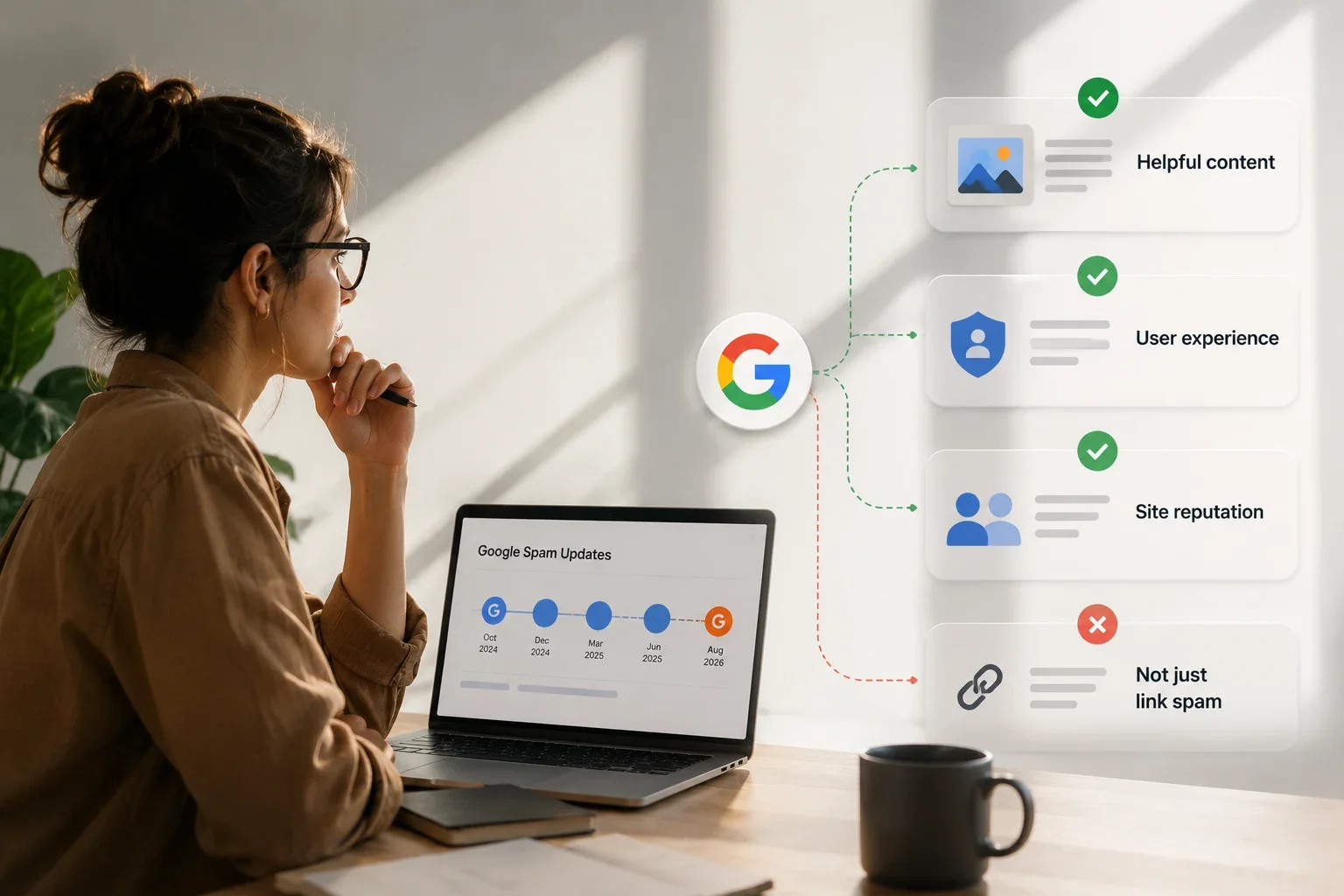
Google's spam updates page tells sites that see a change to "review our spam policies to ensure they are complying with those." On the spam policies page, four policies are the ones to check first if you publish content:
- Scaled content abuse. Google defines it as "when many pages are generated for the primary purpose of manipulating search rankings and not helping users", and lists "Using generative AI tools or other similar tools to generate many pages without adding value for users" as an example.
- Doorway abuse. Pages "created to rank for specific, similar search queries", such as city pages that all funnel to one page. Our breakdown of local microsite networks shows where that line sits.
- Expired domain abuse. An expired domain "purchased and repurposed primarily to manipulate search rankings by hosting content that provides little to no value to users".
- Site reputation abuse. Third-party content published "mainly because of that host's already-established ranking signals". Our post on site reputation abuse and spam updates covers how that policy is enforced.
Open the Manual actions report in Search Console as well. Google says it detects violations "both through automated systems and, as needed, human review that can result in a manual action", so an algorithmic drop and a manual action can look alike in your traffic chart.
Links still belong on the list, just lower down. A spam update that does not target link spam does not make paid links safe. The policy still names "Buying or selling links for ranking purposes" as link spam, and paid links are fine only when "qualified with a rel="nofollow" or rel="sponsored" attribute value".
Match your drop to the dates
Dates are the quickest test. The dashboard's ranking history lists the August 2026 spam update starting August 18 and lasting 2 days and 16 hours. It also lists a September 2026 spam update starting September 24 that lasted 13 days and 16 hours, and a May 2026 core update starting May 21, which is not a spam update at all.
A simple routine:
- In Search Console, set the Performance report to cover two weeks either side of each update window.
- Compare clicks for the week before and the week after each start date, by page.
- If the drop lines up with August 18 to 21, review the four policies above on the pages that fell.
- If it lines up with no update, look at your own changes first: migrations, template edits, removed pages.
If your drop followed a burst of new links rather than an update, our post on rankings dropping after building backlinks covers that pattern. If you are cleaning up after a real link spam problem, read when the disavow tool still applies before you file one.