A forum theory claims Google ranking volatility hits the 1st of the month, three months running. The dated record from Search Engine Roundtable says otherwise.
A theory has been circulating in SEO forums through the summer of 2026: Google search ranking volatility hits almost exactly on the first of the month, three months running, June, July, and August, with Google confirming no update on any of those specific dates. It reads like a real pattern. Checked against the dated timeline that Search Engine Roundtable has been keeping in real time all summer, that pattern doesn't hold up.
Where the claim actually comes from
The theory traces to a single forum comment quoted inside Search Engine Roundtable's August 3rd volatility report: "The event started exactly on 1-Aug-2026 coinciding with previous traffic drops on 1-Jun and 1-Jul." That's one anonymous site owner's recollection, posted as chatter, not a claim made or verified by Search Engine Roundtable itself, and not something any of the volatility-tracking tools quoted in the same article assert.
What the actual dated record shows
Barry Schwartz has been logging every volatility spike on Search Engine Roundtable through the year with specific start and end dates. Lined up, they look like this: the confirmed Google May 2026 core update began May 21 and finished rolling out June 2, with a volatility spike specifically on June 2 as it completed. The confirmed June 2026 spam update began June 24 and finished June 26. Then came an unconfirmed spike nicknamed the "7-Eleven update" around July 11 and 12, another unconfirmed weekend spike July 18 and 19, a third unconfirmed spike around July 24, and finally the August 1 to 3 spike that prompted the forum comment in the first place.
None of those dates land on the 1st of June or the 1st of July. The closest thing to a June 1st event was the May core update finishing its rollout on June 2nd, a day off. The confirmed spam update that same month didn't start until June 24th, more than three weeks later. The nearest thing to a July 1st event was July 11th, ten days off. What happened instead is that Google search saw an unconfirmed or confirmed ranking shakeup roughly every one to three weeks for most of the summer: May 21, June 2, June 24, July 11, July 18, July 24, August 1. Given that cadence, almost any date you picked in advance would land within a few days of some volatility spike. The 1st of the month isn't a special date in this data. It's one of many dates that happened to be close to one of many spikes.
Why the pattern looks convincing anyway
Coverage of this stretch of volatility has run nearly continuously, other trackers and SEO outlets have reported volatility "continuing" or "heating up" in one form or another in multiple separate months through 2026. When the background rate of reported volatility is already that high, pattern-matching on any single recurring date, the 1st, a Friday, whatever, will usually find a coincidence to point at. That's not a flaw specific to this forum comment. It's how noisy, high-frequency data behaves whenever someone goes looking for a calendar-shaped signal in it.
What to check instead of a calendar
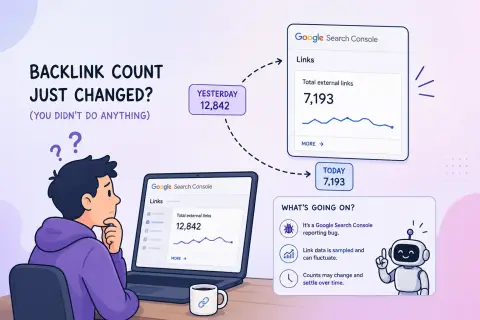
This blog has already made the case that most ranking swings without a confirmed core update don't mean what people assume they mean, and separately documented a real, verifiable case where a metric everyone assumed was a ranking problem turned out to be a reporting bug in Google Search Console. Both are examples of the same discipline this claim needed and didn't get: before treating a pattern in someone else's traffic graph as a fact about Google's calendar, check the dated primary record. In this case, the record was public, kept in real time, and didn't say what the forum comment said it did.