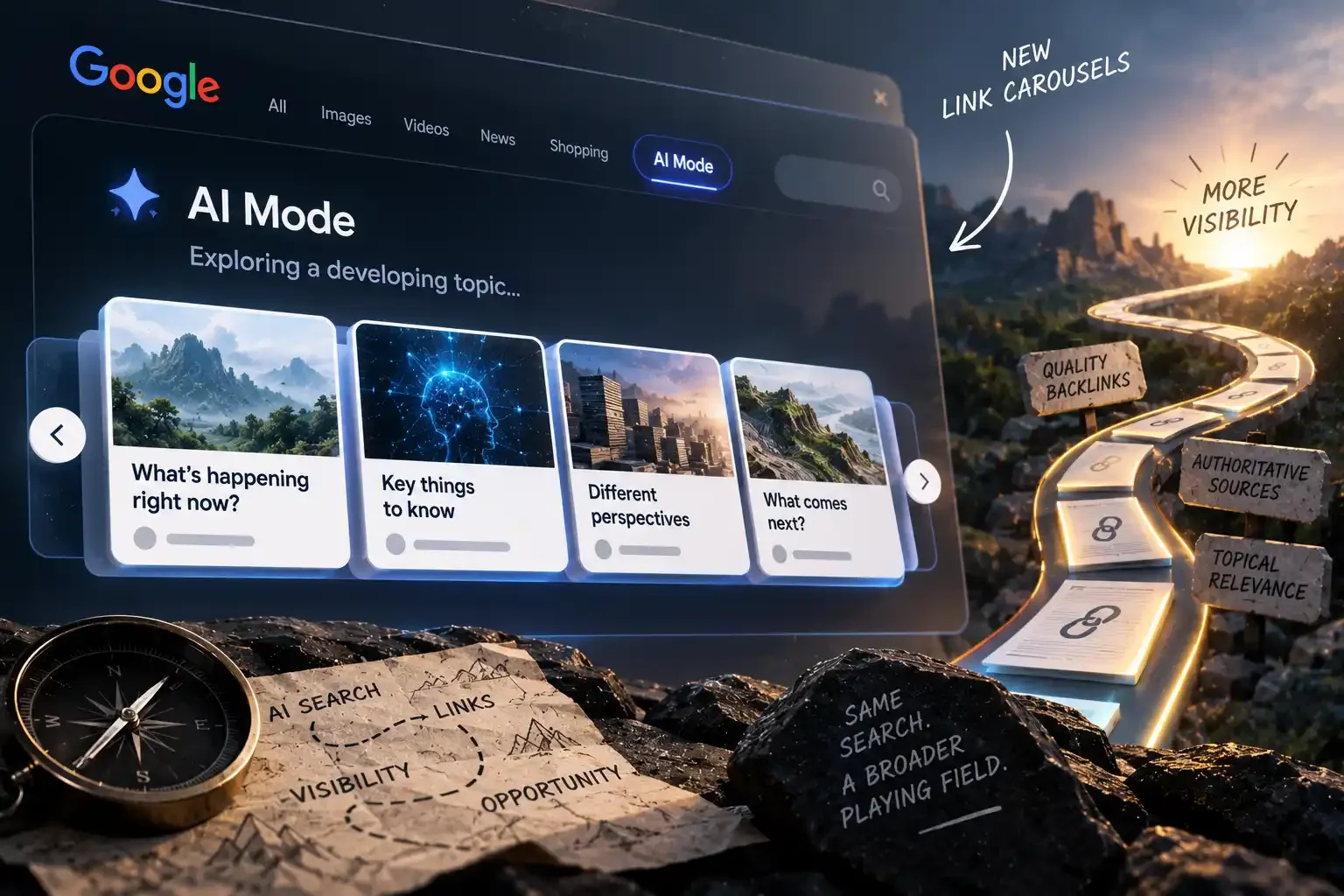
Google confirmed on Aug 25 that its developing-topic link carousel, previously AI Overviews-only, is now live in AI Mode. Here's what determines placement.
On August 25, Robby Stein, VP of Product for Google Search, posted on X that the developing-topic link carousel, a format that had only been showing up in AI Overviews, is now live in AI Mode as well. For anyone tracking whether backlinks still buy visibility inside Google's AI-generated answers, it's worth being precise about what changed and what determines whether a given site ends up inside that carousel.
Where the carousel format actually came from
Google introduced the format on May 27, 2026, in the same announcement that brought Preferred Sources into AI-generated results. Duncan Osborn, Product Manager for Google Search, described it plainly: "for some searches when you have a question about a developing topic, you'll start seeing a prominent carousel, which will also highlight your Preferred Sources." The same post introduced a second, related carousel for firsthand perspectives pulled from forums and social media, and expanded the "Highly Cited" label to more search results. At the time, Google reported more than 345,000 unique sources had been selected as Preferred Sources, up from roughly 90,000 when that feature first went global, and said people click through to a Preferred Source at twice the rate of other links, without publishing how that comparison was measured.
What the August 25 announcement adds is specific to surface, not format. Search Engine Journal and Search Engine Land both covered Stein's post the same week, and both frame it the same way: the carousel had been running in AI Overviews, and as of August 25 it's also showing up in AI Mode responses.
What actually shows up in it
Per both outlets' description of the feature, the carousel is a horizontal row of article cards, each with an image, a headline, a source name, and a publication date, inserted between sections of an AI-generated response. It doesn't appear on every query. Google's own language is "for some searches," which means a developing-topic query might get a text-only response with no carousel at all. When a Preferred Source appears among the results for that query, it gets the same "Preferred" label described in the May announcement, but the carousel itself pulls from a broader set of sources than just ones a specific reader has selected.
The click-data blind spot
Search Engine Land's coverage includes a detail worth sitting with: it's hard to know how many clicks a site is getting from AI Mode, because Google doesn't report on click data in Search Console's generative AI reports the way it does for standard search results. A site can show up in the carousel and there's currently no dedicated filter to isolate whether that specific placement drove any of the traffic in its GSC numbers. The outlet's broader read is that AI Mode should get "more click-friendly" with links surfaced this way, while cautioning that click volume from AI Mode "won't be as high as they were before Google added AI Overviews or AI Mode to Google Search."
What this means for backlink-driven visibility
Neither Google's announcement nor the press coverage of the August 25 expansion describes backlink count, referring domains, or Domain Rating as a factor in which sites land in the carousel. That lines up with data this blog has already covered: Ahrefs' 75,000-brand study found backlinks and Domain Rating carry only a "very weak" correlation with how often a brand gets mentioned across ChatGPT, AI Mode, and AI Overviews, while branded web mentions correlated far more strongly, and AI Mode specifically showed the tightest relationship of the three platforms tested.
The carousel adds a second, separate lever on top of that: Preferred Sources status, which this blog has covered in detail already, is opt-in at the individual reader level and can't be bought or built through link placement, only earned by getting an actual person to click a button on your site. The carousel isn't limited to Preferred Sources, but it's the one place in an AI Mode response where that specific, reader-granted label currently shows up. Put together, showing up in this format looks like a function of publishing something timely and specific enough to match a developing-topic query, plus whatever mix of citation and reader-preference signals Google's models are drawing from, not a placement a backlink campaign can target directly.