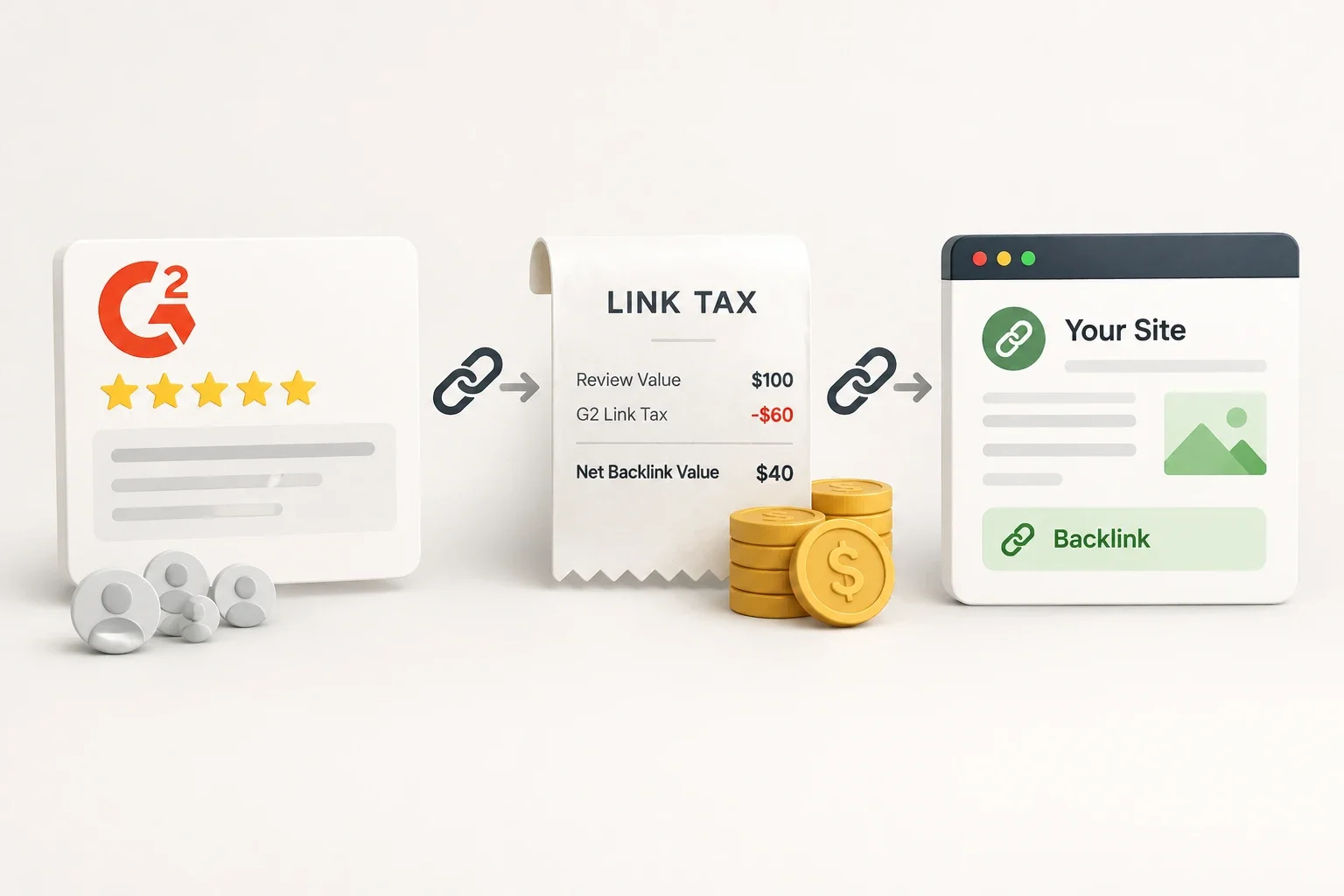
G2's own guidelines tie badges and reviews to a required backlink, by plan tier. One vendor reports G2 also pitching a 3-for-1 link exchange on top of that.
A vendor posted to r/SEO with a specific ask from G2: three dofollow links from the vendor's own content, in exchange for one dofollow link back from G2, whose domain rating the poster put at 92. Read that as a straightforward reciprocal-linking pitch and it looks unremarkable, the kind of unequal trade any high-authority site can propose because it holds the leverage. Read it next to what G2's own published terms already require of vendors, and it looks like a second toll stacked on top of a first one that most vendors don't realize they're already paying.
The backlink requirement that's already built into your G2 profile
G2's Community Guidelines include a "Vendor Content Guidelines Cheat Sheet" that lays out, plan tier by plan tier, what a vendor is allowed to do with the reviews and ratings sitting on its own G2 profile, and what each permission costs in backlinks. On a free plan, referencing your live Grid quadrant placement or displaying the "Users Love Us" badge requires a backlink to your G2 Category page. Move up to Starter, and using any other report-based or milestone badge carries the same backlink requirement. Republishing or quoting an actual customer review, the words a real customer wrote about your product, requires a Professional plan or above, a backlink to that specific review on G2.com, and the reviewer's opt-in. Even the review display widget, the embeddable box of star ratings many SaaS sites run in a footer, "will automatically backlink by embedding," per G2's own table.
None of this is disclosed as optional generosity. It's a plan-gated exchange: G2 hosts reviews that customers wrote for free, and vendors pay for the right to show those same reviews off, partly in subscription dollars and partly in backlinks, every time they do.
G2 isn't unusual here. It's just the one that got asked directly
Blastra read the actual terms of service for G2, Capterra, TrustRadius, SourceForge, and Gartner Peer Insights so vendors wouldn't have to, and found the backlink toll is close to universal, just priced differently. Capterra's own Content Compliance Policy, last updated May 4, 2026, lets any vendor quote a review for free with no paid tier required, but still mandates that "you must include a link back to the corresponding review page, or individual review, when applicable" on every use. TrustRadius skips the free tier entirely: per Blastra's reporting, vendors need an active Content Licensing subscription, sold under the name TrustQuotes, before they can use review content anywhere beyond internal, personal use, and even licensed use still requires a citation and a link back to the original review.
The shape is consistent across all three: the platform hosts content a customer wrote about your product, for free, and then charges you, in cash, in backlinks, or in both, to show that content anywhere else. Blastra's framing of the underlying asymmetry is exact: three parties touch every review, the customer who wrote it, the platform that hosts it, and the vendor whose business the review is about, and in every version of these terms, the vendor sits in the weakest position of the three, "with conditional, rule-bound access" to content about its own product.
What makes the Reddit case different
A mandatory backlink to use a badge you already qualify for is one thing, a cost of doing business on a platform that holds real leverage. What the r/SEO poster describes is a separate ask: an unprompted 3-for-1 link exchange proposal, unconnected to any specific badge, widget, or review the vendor wanted to display. That's not a usage term buried in a guidelines page. That's outbound link-building outreach, the same kind any SEO agency runs, just coming from a company whose entire business rests on being read as a neutral source of buyer intent rather than a party angling for search-engine leverage.
It's one self-reported thread, not a documented policy, so treat the specific 3-to-1 ratio as anecdotal rather than confirmed company practice. But it lands on a pattern that G2's own published terms already establish: a platform that has built backlink requirements into the baseline cost of using your own reviews evidently doesn't see anything unusual about asking for more of them directly, on top of what the guidelines already extract.
What this means for a review-platform strategy
Budgeting for review platforms usually stops at the subscription line item, Professional versus Starter, TrustQuotes licensing versus none. The backlink side of that ledger rarely gets counted, but under G2's and TrustRadius's own terms, it isn't optional; it's the price of the plan doing what the plan is supposed to do. A vendor who upgrades to Professional specifically to republish a strong customer quote is also committing to link back to G2 every time that quote appears, on the website, in a sales deck, in an ad, for as long as the quote stays up.
That's a fair trade when the review platform is sending buyer-intent traffic and the backlink is going to a category or profile page that's genuinely relevant to link to anyway. It's a worse trade when a vendor is quietly meeting the same backlink obligation across five different review platforms at once and never added up what that's costing in outbound link equity to sites the vendor doesn't control and can't audit. And a direct, unsolicited exchange pitch on top of the built-in requirement is worth declining or at least negotiating down, since it's asking for outbound links with no attached usage right in return, just G2's word that a DR 92 link back is worth the trade.
Where this differs from what's already on this blog
How to vet a backlink placement before paying for it covers a different transaction: buying a placement from a publisher, where the backlink is the entire product being purchased. This is the reverse situation, a platform that's already hosting your content for free and then charging a backlink, on top of a subscription, for the right to use it elsewhere. The filler-listing piece on backlink directory packages is about junk inclusion sold in bulk with no real audience behind it; G2, Capterra, and TrustRadius are the opposite problem, real audience and real buyer intent, with usage rights gated behind a fee structure vendors rarely read closely enough to notice.
A straightforward backlink directory listing skips this entire calculation. There's no tiered plan gating what a vendor can say about its own listing, no backlink owed back to the directory just to mention that the listing exists, and no reciprocal-exchange pitch riding along with it. Inclusion is inclusion, not a licensing relationship that has to be re-negotiated every time a badge gets used somewhere else.