A vendor claims three follow-ups double results. A 20-million-email dataset and a small backlink test both show the gains front-load into follow-up one.
SalesHive's guide to SEO outreach makes a specific, appealing claim: "sequence data suggests that sending three follow-ups can double results compared to a single email." It's the kind of stat that justifies building out a full four-touch sequence. It's also not what happens when you look at what each individual follow-up contributes, in either a massive general cold-email dataset or a small backlink-specific one.
What a 20-million-email dataset shows
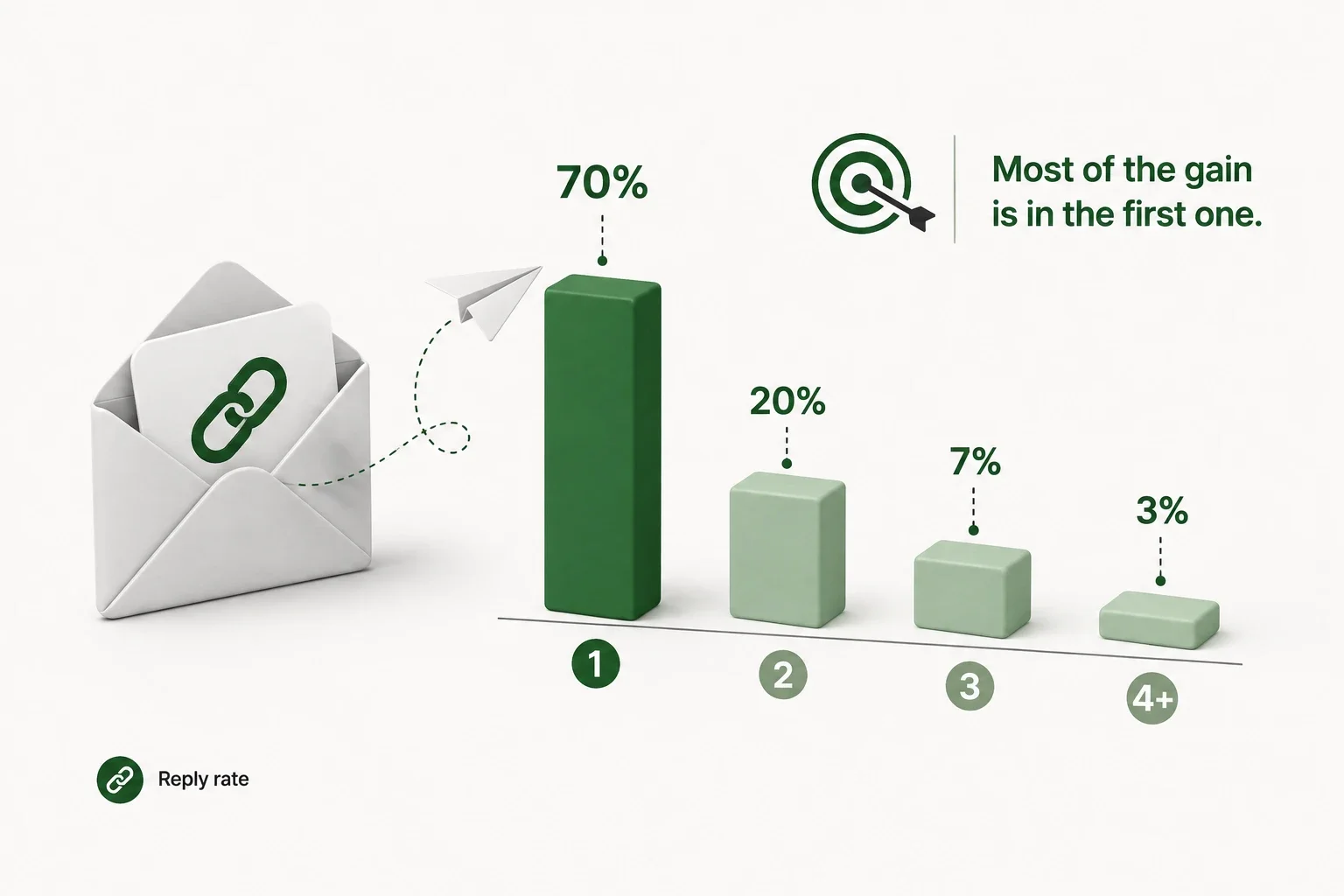
Woodpecker's 2026 benchmark report, built from over 20 million emails sent through its own platform, breaks reply rate down by sequence step instead of just reporting a sequence-wide total. The first email averages a 3.43% reply rate and accounts for 58% of all replies in a sequence. The first follow-up is where the real jump happens: an 8.4% reply rate on its own, citing Belkins data, often higher than the initial email itself, and adding a single follow-up to a sequence increases total replies by 65.8%. The second follow-up adds another 3 percentage points on top of that, which Woodpecker calls "an incremental lift." The third follow-up isn't given a number at all. Woodpecker's own note on it: "returns begin to diminish at this stage."
Lay that out as a sequence and the shape is obvious: a big jump on follow-up one, a smaller add-on for follow-up two, and a fading contribution by follow-up three. That's a curve bending toward zero, not a doubling that keeps compounding every time you send another email.
What an 815-email backlink test shows
A smaller, backlink-specific version of the same pattern showed up recently on r/seogrowth, where someone testing follow-up cadence across 815 backlink outreach emails posted their step-by-step numbers: 5.8% replied to the initial email, 7.1% after the first follow-up, 7.6% after the second. Do the arithmetic on that and the first follow-up added 1.3 percentage points, a 22% relative lift. The second follow-up added half a point, a 7% relative lift on top of the new total. This is a single self-reported sample, not a controlled study, and it's far smaller than Woodpecker's dataset. But it lands on the identical shape: most of the value shows up after the first nudge, and each additional touch buys less than the one before it.
Why "three follow-ups doubles results" survives anyway
The claim isn't fabricated. Compare a single email's reply rate to a full four-touch sequence's total reply rate, and a roughly two-times difference is a reasonable way to describe the gap. Where it becomes misleading is in what it implies about the third follow-up specifically, that it's carrying a third of the value in a sequence generating double the results. Both datasets here say otherwise: the second and third touches are still worth sending, they're just splitting a much smaller slice of the total gain than the sequence-wide framing suggests.
That distinction matters for how you plan an outreach cadence, which has already covered what makes an individual message land. Cadence is the other half of that equation, and the data says to spend the most effort on making the first follow-up count, since it's doing most of the sequence's real work, rather than treating all four touches as roughly equal contributors to a 2x multiplier.
What this means for a real sequence
None of this argues against following up. Skipping follow-ups entirely means giving up 42% of the replies a sequence would otherwise generate, according to Woodpecker's data, since well under half of all replies come from the first email alone. The actionable read is about where to put the effort: the first follow-up deserves the same care as the original pitch, since it's the single highest-converting step in the whole sequence. The second and third follow-ups are still worth the low cost of sending them, but budgeting time to write a genuinely new angle for touch four because "follow-ups double results" is chasing a return that the step-by-step numbers don't back up.
Where this differs from what's already on this blog
The anatomy of a link outreach email that gets replies covers what to put in a single message, subject lines, structure, the ask itself. This is about a different variable: how many messages to send and where the returns on sending more of them taper off. A well-written email and a well-planned sequence solve different parts of the same problem.
A directory listing skips this calculation, since there's no outreach cadence to plan around it. It's either accepted for inclusion or it isn't, with no follow-up sequence needed to get there.