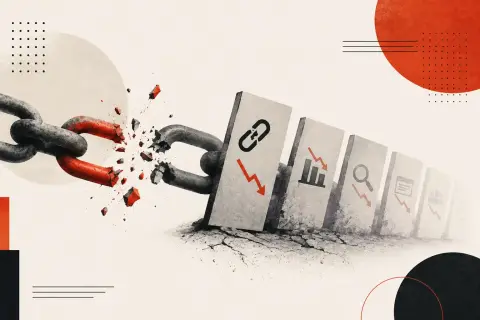
Most pages never get a first backlink. Here is how to measure your own wait in four steps, and where the 427-day Ahrefs figure on roundups leads.
Time alone does not bring a first backlink. Most pages never get a link at all, and the ones that do get it because someone had a reason to cite them. So the number worth knowing is your own. You can work it out with Search Console and a backlink tool, and it will tell you more than a 427-day figure credited to Ahrefs on a statistics roundup.
Most pages never reach a first link
Two large datasets point the same way. Backlinko's content study, built with BuzzSumo on 912 million blog posts, found that "94% of the world's content gets zero external links." The page was last updated in 2019, so treat it as the shape of the web rather than a 2026 count.
Ahrefs' search traffic study measures Google traffic, not links, and finds that "96.55% of all pages in our index get zero traffic from Google". The same page also says "Plenty of pages get organic traffic while having no backlinks", and adds "but from what I can tell, almost all of them are about low-competition topics." So a page without a first link can still earn visits, mostly on easy queries.
If most pages never get a link, a waiting time in days only describes the minority that did. Any single time-to-first-backlink figure leaves out the pages that are still waiting, which is most of them.
Where the 427-day figure leads
The figure says Ahrefs studied 1.1 billion pages, found 95.2% with zero external backlinks, and that the median page waited 427 days for its first one. The statistics roundup that carries it states it as fact, with no link in the sentence.
That page ends with a plain list of sources that does not say which source backs which statistic. Its first entry is SEO.ai's link building statistics page, and that page has no 427-day, 95.2% or 1.1 billion figure. Its nearest claim is that "94% of online content doesn't receive external links". Ahrefs' traffic study, cited above, uses about 14 billion pages and counts search visits, not days to a link. Checked on October 23, 2026, the trail ends there, and no other primary study we found publishes a median wait for a first link. If you have the primary page, send it and we will update this post.
The figure also fails a simple logic test. If 95.2% of pages have no link, only 4.8% do, and a median wait can only be taken from that 4.8%. A number built that way says nothing about how long your page will wait, because it skips every page that is still at zero.
How to measure your own time to first link
You need the page's publish date and the earliest date any tool saw a link to it.
- Get the publish date. Your CMS shows it, or use the date in your sitemap if you set it on publish.
- Check Search Console. Google's Links report help page says the report "includes links that Google has found over time" and that it "shows a sample of internal and external links". Its Latest links export holds "The most recently discovered links to your site (up to 100,000 rows), sorted by discovery date." For a new page on a small site, the oldest row for that page is a first estimate. On a site with more links than that, older links drop out of the export. Because the report is a sample, an empty result does not prove the page has no links.
- Cross-check in a backlink tool. Filter referring domains to the exact URL and note the earliest date the tool shows. A crawler can only date a link from the day it found it, so this date is the latest the link could have appeared, not the day it was published.
- Subtract. Days between publish and the earliest date from steps 2 and 3 is your time to first link.
A worked example, with made-up dates: a post goes live on March 3, 2026 and the earliest referring domain shows up on June 19, 2026. That is 28 days left in March, 30 in April, 31 in May and 19 in June, or 108 days.
Run it on ten posts. Put the posts with a link in one list and sort the days; with ten linked posts, the median is the average of the fifth and sixth values. Keep the posts with no link yet as a separate count. That count matters more than the median: if six of ten posts have no link after six months, the problem is not patience.
What shortens the wait
A rule of thumb we use, based on experience rather than a study: if a page has no referring domain after about 90 days, waiting longer rarely changes it. Give people a reason to cite it instead. Original numbers, a free tool, a clear method, or a correction someone can check are the usual reasons. Then tell the people who would use it.
A first link is not what gets a page found. Google's How Search works guide says "Still other pages are discovered when you submit a list of pages (a sitemap) for Google to crawl." Submit the sitemap on day one and treat links as a separate job.
Once a page ranks, links tend to keep coming. In Ahrefs' backlink growth study, which looked at the top-20 ranking pages for 10,000 keywords, most #1 pages gained followed backlinks at "a pace of between +5% and +14.5% per month". That is a study of pages that already rank, so it says nothing about the wait before a page breaks through.
Do not shortcut the first link by paying for it. Google's spam policies define link spam as "the practice of creating links to or from a site primarily for the purpose of manipulating search rankings" and list "Buying or selling links for ranking purposes" first. If you are pricing it anyway, our post on what a guest post costs compares published price studies and why their numbers differ.
When the first link arrives
Check that it counts before you log it. SerpCrest's bulk DoFollow checker checks up to 100 URLs per run and reports if each link is still active, DoFollow and indexed. If a link shows on the page but never appears in Search Console, our post on why some backlinks never get indexed covers the usual causes. For a brand-new site with no links at all, see whether a new domain can rank with zero backlinks. And when the next precise-sounding statistic turns up, run it through the steps in how to trace a backlink statistic to its source before you plan around it.