A vendor calls unindexed backlinks "literally worthless." Google's own John Mueller called the same question unresolved. Here's the actual evidence.
"I have a ton of backlinks that have still not been indexed by Google in 4 months," someone posted on r/localseo this week. "These backlinks are of high DA and relevance." That confusion is exactly what a growing crop of "backlink indexing" vendors are built to monetize. One 2026 guide puts it in the starkest terms possible: "A backlink that Google doesn't index is no backlink at all... It is literally worthless. No authority transfer. No trust flow. No ranking power. No movement." That's a confident claim for a question Google's own John Mueller has publicly declined to answer cleanly.
What "not indexed" means in Search Console
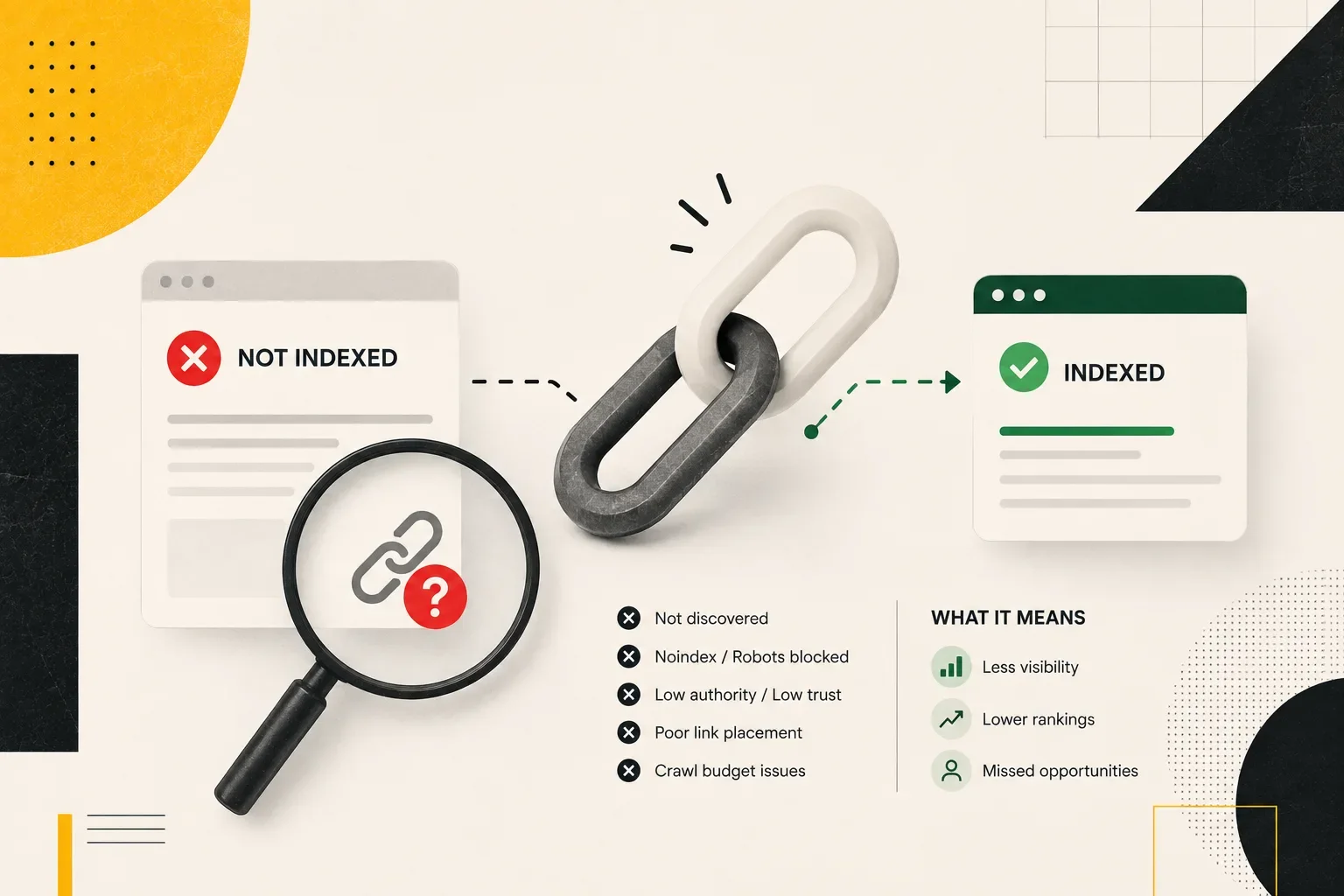
Start with what the status itself is telling you. Google's own Page Indexing report documentation splits unindexed pages into different categories, and two of them get confused constantly: "Discovered - currently not indexed" means Google found the URL, usually via a sitemap or another link, but hasn't crawled it yet, often because crawling it right then risked overloading the site. "Crawled - currently not indexed" means Google fetched the page and made a deliberate call not to add it to the index, typically because the page didn't look valuable enough on its own to justify a slot.
Neither status is really about your link. Both describe Google's assessment of the linking page as a whole: its crawl priority, its authority, and its perceived usefulness to searchers. A high-DA site that's slow to get crawled, or that publishes a firehose of thin pages, can leave a genuinely good backlink sitting in "not indexed" limbo for reasons that have nothing to do with the domain that placed it or the domain being linked to.
Does an unindexed page's link still count?
This is the part vendors gloss over, because the honest answer is that Google itself hasn't settled it. In November 2019, John Mueller stated on Twitter that "links are between indexed URLs, so if one side is gone, the link is ignored." A year later, Google's Gary Illyes said the opposite in practice: "something with noindex will never reach the serving index, but we will have the fetched copy for things like link graph calculation," meaning Google might still use a noindexed page's outbound links when computing its link graph even though the page never shows up in search results. When someone pointed out the contradiction directly to Mueller in January 2021, his reply was blunt: "It depends. And it doesn't matter in the bigger picture, so I'm happy to leave it open."
That's about as close to an official answer as this question has ever gotten, and it isn't the clean yes or no that a "literally worthless" framing implies. Google's own most senior public spokesperson said explicitly that the distinction doesn't matter much in the bigger picture.
The bigger picture Mueller was pointing at
That "bigger picture" comment lines up with something Mueller has said elsewhere and on the record: the total count of your backlinks doesn't factor into ranking the way most SEOs assume. Asked directly about it, he told Search Engine Journal, "the total number doesn't matter at all... you could go off and create millions of links across millions of websites if you wanted to, and we could just ignore them all," while "one really good link from one website out there" can be a strong relevance signal on its own. If Google's own systems aren't tallying every link the way a rank-tracking dashboard does, whether one specific placement shows a green checkmark in an indexing tool matters even less than the checkmark suggests.
What causes a linking page to sit unindexed
The mechanical reasons a page doesn't get indexed are well documented and boring, which is exactly why they don't make for a good sales pitch. The linking domain's own crawl budget is the biggest factor: every site gets a queue-based allowance for how often and how deeply Googlebot bothers to explore it, and a lower-authority domain can sit in that queue for weeks. A page can also be an orphan, meaning nothing else on that site links to it, so there's no path for Googlebot to find it beyond a sitemap entry it may never prioritize. And thin or duplicate-feeling content gets deprioritized regardless of how many good links point to the page linking to you, since Google is evaluating the linking page's own quality, not the value of the link it happens to contain.
None of that is something you can fix from the outside. It's a property of the linking site's own crawl history, structure, and content quality, the same factors this blog's guide to vetting a placement before paying already recommends checking before you buy a link in the first place: not just Domain Authority, but whether the site is indexed at all, actively crawled, and free of the thin-content patterns that keep pages stuck in "crawled, not indexed" purgatory.
Why paying to "force" indexing usually treats the wrong problem
Given that a page usually isn't indexed because Google judged it low-value or low-priority, paying a service to submit it through pinging tools or third-party indexing APIs doesn't change that underlying judgment. It's asking Google to reconsider a page it already looked at and passed on, or to jump a low-authority site ahead of its normal crawl queue. Sometimes that works for a few days. It rarely holds, because the page's actual authority and content quality haven't changed, only the request to revisit it has. If a linking page consistently won't index on its own, that's information about the quality of the placement, not a problem to route around with a paid workaround.
What's worth checking
The site: search operator that most guides recommend for confirming indexation isn't fully reliable either, since it shows a partial view rather than a complete one, particularly for lower-authority domains. Google Search Console's own coverage data, where you have access to it, is more trustworthy than a site: query for your own pages, but for someone else's linking domain you're stuck estimating from the outside. Given the genuine uncertainty here, the more useful question isn't "is this exact link indexed today," it's whether the site hosting it is the kind of actively crawled, genuinely useful domain that gets indexed reliably as a matter of course, the same signal this blog's coverage of the recent GSC Links report bug points back to: the count Google shows you is noisy and worth checking directly rather than trusting at face value, in either direction.
Where this differs from what's already on this blog
The backlink-vetting checklist covers what to check before you pay for a placement. This post covers a narrower, related worry that comes up after the fact: a link is already live, and it's not showing as indexed. The honest answer, straight from Google's own mixed and half-resolved public statements, is that this matters far less than the vendors selling "backlink indexing" fixes want you to believe.
A directory listing sidesteps most of this uncertainty, since a legitimate, actively maintained directory is itself a well-crawled, frequently indexed page by design, not a thin one-off blog post competing for crawl priority against thousands of others on the same low-authority domain.