Explore 'Money-Hat SEO' – what it means to prioritize profit over traditional SEO hats. Unpack James Dooley's controversial approach. Is it for you?
"I'd just say I'm a money hat SEO. I do what works." That's James Dooley, on a podcast episode published in late July, refusing to answer a question about where he sits on the white hat to black hat spectrum. It's a good line, and it's spreading through SEO Twitter and YouTube the way good lines do. It's also a dodge, and worth unpacking rather than repeating.
Dooley is a UK lead-generation operator who runs sites across dozens of niches and was recently named SEO Entrepreneur of the Year 2026 in a marketing-industry press release, a title worth reading as promotional rather than independently judged. He also sells an SEO course. Neither of those facts makes what he says wrong, but they're worth knowing before you weigh how much to trust the pitch.
What "money hat" actually means, in his words
Talking to podcast host Edward Sturm in a July 25 episode of The Edward Show, Dooley lays out the term directly: the white hat/gray hat/black hat framing is a distraction, and the only question that matters is whether a tactic makes money without wrecking the site long-term. He's explicit that the risk tolerance is bounded, not absent: he'll test tactics aggressively, but the constraint is whether it "jeopardizes long-term success," not whether it fits Google's definition of acceptable.
That's a coherent position. It's also just a rebrand of a very old argument (results over rules), dressed in a term catchy enough to make the rounds. The interesting part isn't the philosophy. It's what he says the philosophy leads him to actually do.
What's inside the money-hat toolkit
Across the interview, Dooley names four tactics as part of his current stack, each of which maps directly onto something Google's spam policies for web search names specifically:
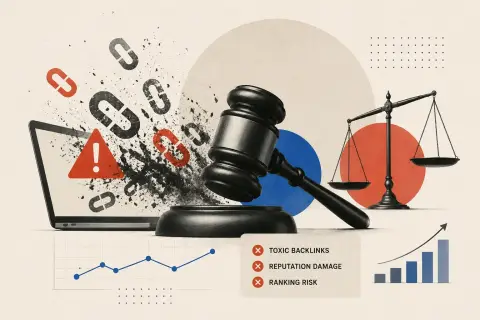
Private blog networks. "PBNs still actually work pretty well. I think people moved away from PBNs, but they seem to be working again now," he says. Google's policy doesn't have a PBN-specific line item, but PBNs are textbook link spam: "using automated programs or services to create links to your site" and building links "primarily for the purpose of manipulating search rankings."
Parasite SEO. He describes it plainly: "Can you go and leverage a high DR site and then do an article on there? Hit that article with some virality indexing and maybe some tier 2 backlinks." Google added a policy for exactly this in 2024 and calls it site reputation abuse: publishing content on a host site "mainly because of that host's already-established ranking signals" rather than its own.
Expired domains. "We're doing a lot with expired domains," he says, naming a domain broker he buys from regularly. Google's policy on expired domain abuse covers repurposing an expired domain "primarily to manipulate search rankings by hosting content that provides little to no value to users."
Force-indexing social and third-party content, so posts on Reddit, LinkedIn, or other platforms show up faster in Google and AI systems. This one sits in grayer territory. It's not explicitly banned, but it's the same instinct as the other three: find the shortcut a system hasn't closed yet.
Across the full transcript, he never once uses the words "illegal," "risky," "against guidelines," or "scam." The framing is pragmatic, not about compliance. That fits his own definition of the term. It also means the work of translating "still works" into "is this a good idea for my site" is left entirely to the listener.
The one part of the pitch that isn't a shortcut
Buried in the same conversation is a genuinely useful, lower-risk claim: Dooley argues that unlinked brand mentions, especially when tied to a defined entity, can be worth as much as a backlink, sometimes more. "If it's defined within a semantic triple, I would say it's even better," he says, adding that he's "absolutely fine with not getting a link" when the mention improves what he calls his "confidence score" inside a brand's Knowledge Graph entry.
That's his own practitioner testimony, not a peer-reviewed finding, and Google has never confirmed a "confidence score" by that name. But it's directionally consistent with what independent research has already shown: an Ahrefs correlation study of 75,000 brands, summarized in Search Engine Journal, found branded web mentions correlate far more strongly with AI-answer visibility (0.656–0.709) than backlink count does (0.191–0.244). Whatever you think of PBNs, the mentions-matter argument doesn't require breaking anything.
He makes a similar point about nofollow links carrying real value through third-party corroboration, which lines up with what SEOs have been finding in nofollow-vs-follow correlation data all year. None of that needs a "money hat" to justify. It's just accurate, and it's the part of this interview worth keeping.
The part that's really just a leak confirming old guesses
Dooley also credits the May 2024 Google API leak, roughly 14,000 leaked internal attributes, for validating what he'd been testing for years: that user signals (click-through rate, branded search volume, social traffic) drive rankings through a system called NavBoost. That part checks out independently. The leak's publisher, Rand Fishkin, documented the specific click metrics (goodClicks, badClicks, lastLongestClicks) that NavBoost tracks, and called it a leak of a scale that had "never been reported from Google's search division" in the prior quarter century. Google engineer Eric Lehman separately testified under oath during the DOJ antitrust trial that "clicks are the main signal used by NavBoost." Dooley isn't wrong here. He's just one of many practitioners who'd already guessed correctly, and the leak proved it.
What to actually take from this
"Money hat" isn't a new risk category between white and black hat. It's a rebrand of "I'll accept the risk if the payoff is big enough," which is a real, defensible position for an operator running dozens of disposable lead-gen sites where losing one to a manual action is a rounding error. It's a much worse position for a business running one site it can't afford to lose. If a PBN or a parasite placement gets caught, you're not paying a fine. You're starting over.
The parts of Dooley's framework that don't require gambling with your only domain (chasing unlinked entity mentions, treating nofollow links as more than a consolation prize, paying attention to click and engagement signals) are worth adopting no matter what hat color you assign yourself. The parts that do require gambling are worth naming accurately before you try them: not "money hat," just the same black-hat tactics that have always carried the same risk, still working right up until the point they don't.
That distinction, a site with real sustained authority versus one temporarily gaming a leaked ranking system, is exactly what a vetted backlink directory is supposed to save you from having to guess at on your own.