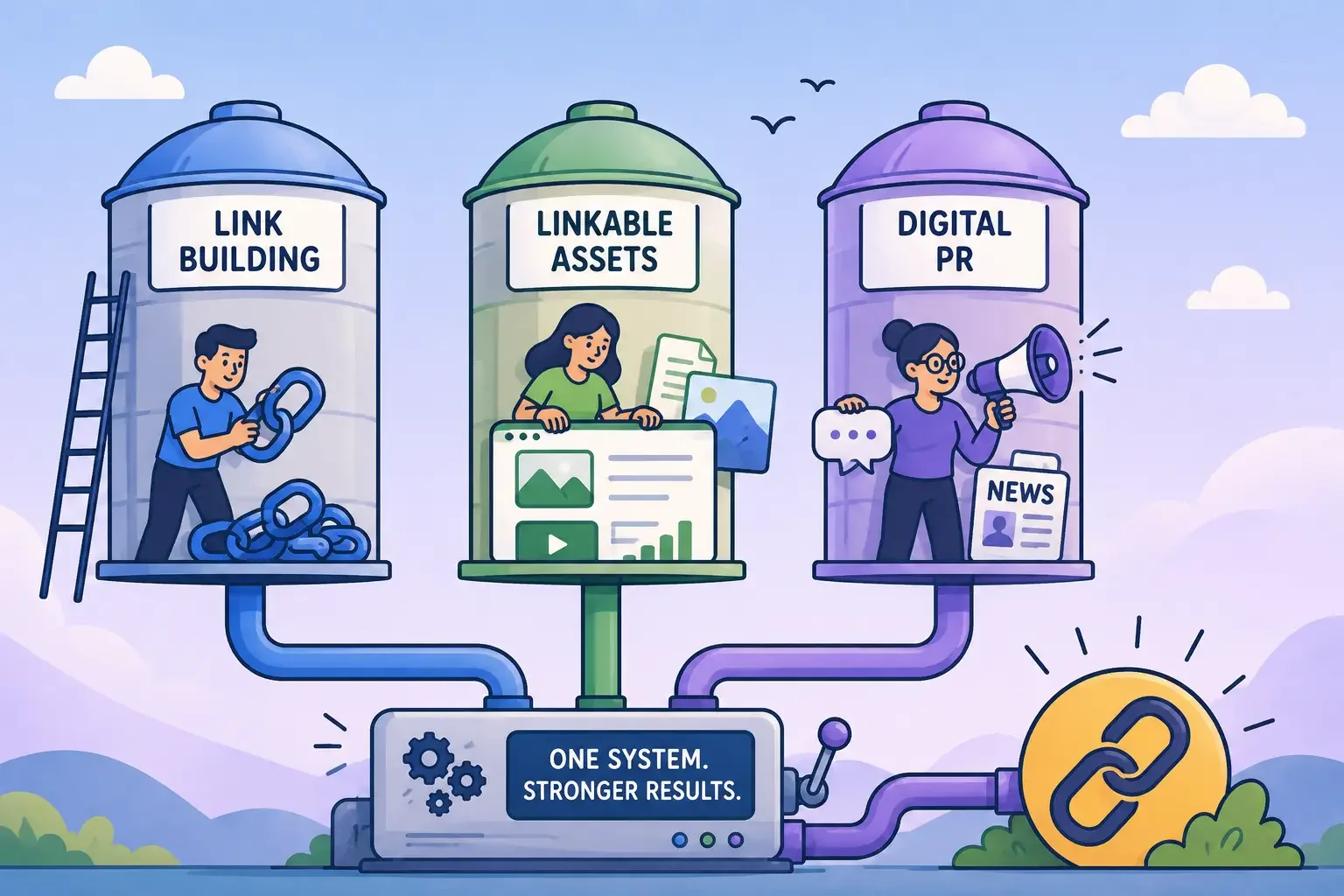
Link building, linkable assets, and digital PR are usually run separately. Case studies show why treating them as one system moves links to money pages.
Canva's business name generator has close to 2,000 followed links from unique domains. None of them come from a media outlet. A U.S. Chamber of Commerce article that pulls over 30,000 organic monthly clicks links out because of a third-party stat someone aggregated, not because anyone pitched it. A Gusto survey on AI-driven job anxiety picked up more than 40 referring domains without a single cold outreach email asking for a link. Three different link-acquisition mechanisms, three completely different reasons they worked, and if you're running all three under one undifferentiated "link building" line item, you're probably misreading why any of them succeed or fail.
That's the case Evelina Milenova, an SEO specialist at Hostinger who has worked on link acquisition across more than 90 SaaS brands, lays out in a Search Engine Land piece published August 13, 2026. Her argument isn't that any one of these tactics beats the others. It's that they're mechanically different, they fail in different ways, and most teams get worse results than they should because they don't treat them as three legs of one system.
Three different asks, three different failure modes
Milenova draws a specific line between the three approaches. Link building means an explicit ask: guest posting, broken-link outreach, or asking a site to add a mention. Linkable assets are content that attracts links without you asking, things like a free calculator, a template, or a stats roundup, earned purely on the appeal of the content itself. Digital PR is a story you pitch to journalists, where the ask is coverage, not a link, and any link is a byproduct of the story being newsworthy.
Each one breaks differently. Link building gives you the most control over which page gets the link and what anchor text it carries, but it doesn't scale without running into Google's link-spam policies on buying links or excessive exchanges. Linkable assets scale cleanly and compound over time, but a tool or stats page almost always earns links to itself, not to the commercial page you actually want ranking. Digital PR can spike hard when a story lands, but a PR professional can't guarantee any given pitch gets picked up, and its links point at a linkable asset or your homepage, rarely at a converting page directly.
What the case studies actually show
Canva's name generator is the clean example of a self-earning asset doing exactly what it's supposed to do and nothing more: close to 2,000 links, zero from a reputable media outlet, because a free tool is useful enough to link to but isn't itself a story. The same tool did eventually appear in Inc. and Fast Company, but only as supporting evidence inside a broader piece about AI, not as the pitch itself. That's the distinction Milenova draws between an asset that earns links passively and one that's actually PR-worthy: usefulness earns citations, but it takes a real hook to earn coverage.
Hostinger's own Chamber of Commerce link worked through the same self-earning mechanism from the other direction: a page built by aggregating third-party statistical data, easy for a writer chasing a data point to find and cite, hard to pitch to a journalist because the underlying numbers aren't proprietary. Gusto's survey took the opposite route on purpose, small proprietary sample size layered with free Google Trends data for state-level detail, avoiding the cost of a nationally significant sample while still producing something original enough to earn more than 40 referring domains.
None of these three examples sent meaningful link equity to a commercial, converting page. That's not a flaw in the tactics. It's what self-earning assets and PR-driven coverage structurally do: they earn links to themselves. Getting that equity to a landing page or a converting blog post takes a deliberate internal link from the asset to the commercial page, a step Milenova flags as the part teams skip most often.
Why this matters more with AI search in the mix
There's a second reason to stop treating these as interchangeable: they don't carry equal weight for AI visibility. An Ahrefs study of 75,000 brands found branded web mentions correlate with AI Overview visibility at 0.664, more than three times the correlation for raw backlink count at 0.218. Linkable assets and digital PR generate exactly the kind of unlinked and nofollow brand mentions that study found matter most for AI visibility, alongside whatever followed links they happen to earn. Link building alone, the tactic best at delivering links to money pages, is comparatively weak at generating that broader mention footprint.
That's a real tension, not a reason to pick one lane. It means link building and the other two approaches are optimizing for different outcomes that both matter, and treating them as one undifferentiated "backlinks" goal obscures which one you're actually short on.
Making the three work as one system
Milenova's framework has each tactic feed the next rather than run in parallel and separate: a guest post link seeds a new stats page, an internal link from that stats page passes equity to the commercial page it supports, the stats page's early traction becomes the hook for a PR pitch, PR outreach to sites that covered the story but didn't link becomes a fresh link-building target, and the original story keeps earning links on its own long after the pitch cycle ends. Each stage produces the raw material the next stage needs.
That loop is a different problem than the ones this blog has already covered. The digital PR piece is about running PR outreach well as its own channel. The internal linking piece is about crawl budget and equity distribution across pages you already control. This is neither: it's about the handoff between three separate external link-acquisition channels, and the specific, common failure of earned links landing on an asset page and stopping there instead of reaching the commercial page that needs them.
What this actually changes
If your linkable assets and PR wins aren't showing up as ranking movement on your money pages, the tactics probably aren't broken. The internal link from the asset to the commercial page is what's missing, and it's the cheapest fix in this entire framework: no outreach, no pitching, just a link you already have full control over. Link building still earns its place for the pages that need control over anchor text and placement, but it shouldn't be the only channel doing the work, and it's the one channel where you can't hide from Google's own limits on how far it scales safely.
A backlink directory covers one piece of the link-building leg. Where the assets and coverage you already earn actually go once they land is still on you.