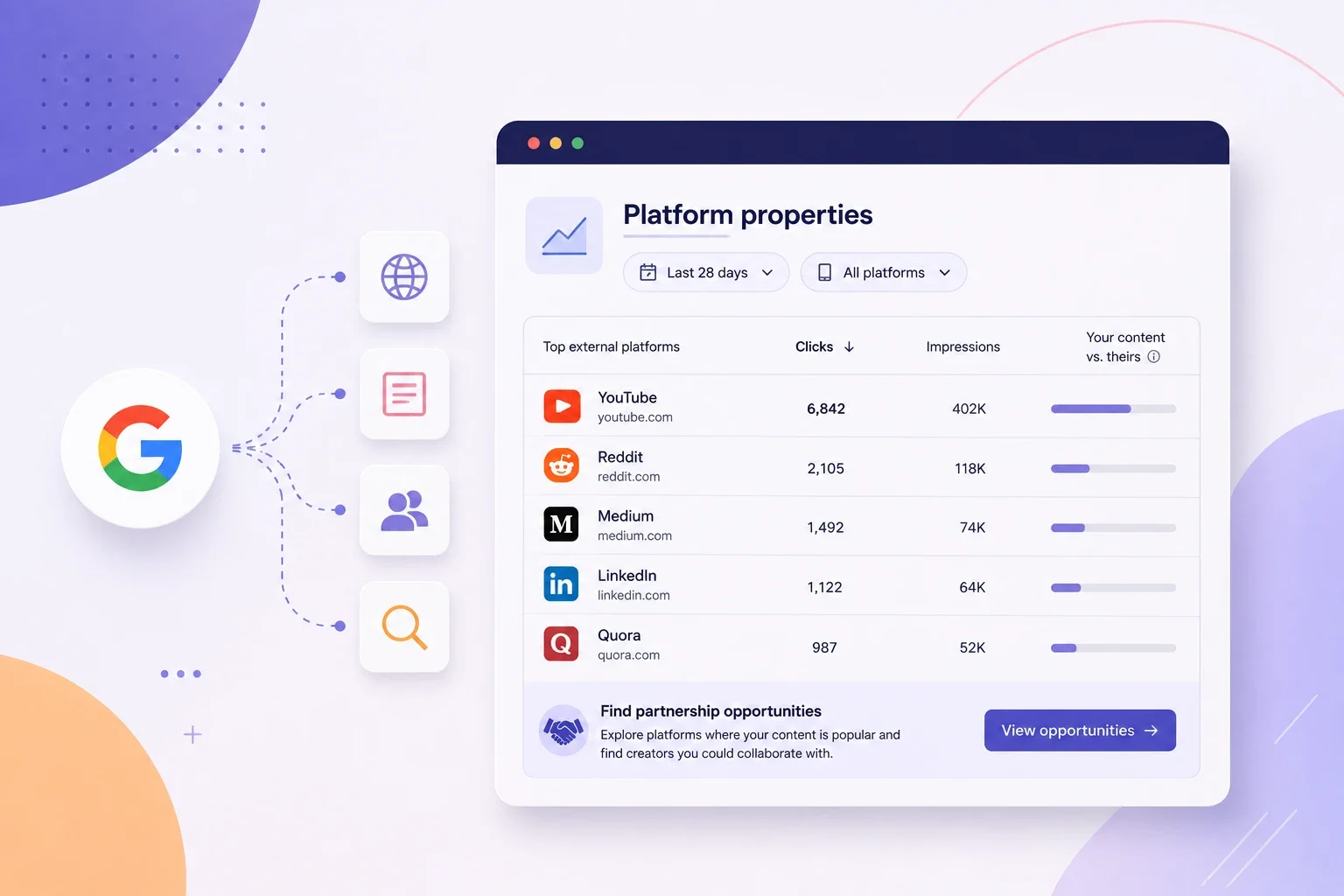
Google Search Console can now show which of your social posts already rank, and which searches they win that your website doesn't. Here's how to use it.
On July 7, 2026, Google shipped platform properties, a new Search Console property type that lets you verify an Instagram, TikTok, X, or YouTube account and get the same first-party search performance data GSC has always given website owners: clicks, impressions, CTR, average position, and the actual queries behind them, now pointed at a social account instead of a domain. Google took it fully global three weeks later, on July 29, rolling it out to every Search Console account. Coverage spans Search, Discover, and Google News, so a TikTok clip or a YouTube Short can be tracked the same way a blog post always has been.
What it actually is, and isn't
This is not a backlink tool. It doesn't award links, track them, or measure link equity in any form. What it measures is demand: which specific search queries are sending clicks to your (or a partner's) social content, and how that traffic is trending. Search Engine Land's Ashley Liddell frames the most useful workflow around three mechanics confirmed in Google's own Insights report documentation: queries get grouped into top, trending-up, and trending-down clusters, and that grouping is adjustable by date range and filterable by specific post URLs, letting you compare formats like Reels against static posts directly.
One claim is worth being precise about. Liddell's piece also describes a "24-hour filter" that lets you catch a post gaining search traction within a day of going live. Google's own documentation for the Insights report describes an adjustable date-range selector and trending-up/trending-down classification, not a feature specifically named or scoped to 24 hours. Treat the fast-turnaround read as Liddell's practitioner interpretation of how the trending mechanic behaves in practice, not a discrete, officially documented setting.
Two structural facts matter more than any single UI detail. First, there's no historical backfill. Google's own help center confirms new properties show partial data limited to "the days since collection started," so every week a brand hasn't verified its accounts is query data that's gone for good. Second, this is entirely first-party. You only see performance for accounts you can verify, meaning your own data and nothing else: no competitor visibility, no category benchmark, no way to tell whether 400 monthly clicks on a post is strong or embarrassing for your niche. It has to sit alongside ordinary keyword and SERP research, not replace it.
Where the actual opportunity-finding happens
Liddell's own hypothetical is the clearest illustration: a running shoe brand connects its Instagram and YouTube properties, and the Performance report surfaces a Reel about lacing techniques for wide feet pulling steady clicks from Google for "how to lace running shoes wide feet," a query the brand's own website has no page targeting. That single data point resolves three questions at once: there's proven demand (people are searching and landing on the content), it's currently captured in a format that earns clicks but doesn't convert (a Reel sells nothing), and the brand now has the exact query language to write the page that would.
Run that logic in reverse and it's just as useful. If a social post already ranks well for a query, that's a real argument against commissioning a competing page for the same term, something a keyword tool's estimate can't tell you but a first-party click record can.
The creator-partnership angle, and why it connects to the last post on this blog
This blog just covered other people's audiences as a way to borrow trust and distribution from an audience owner rather than pitching a journalist for coverage. Platform properties data feeds that exact decision with evidence instead of guesswork. Query groups show which conversations a brand already has traction in, and by omission, which ones it doesn't, turning a creator brief from "find someone with reach" into "find someone whose audience already searches for the specific query cluster we're absent from." Liddell makes the reciprocal point too: the same data lets a creator show a brand that their content genuinely ranks for real searches, not just racks up views, so both sides of a partnership negotiation are working from the same evidence rather than one side's follower count and the other side's hope.
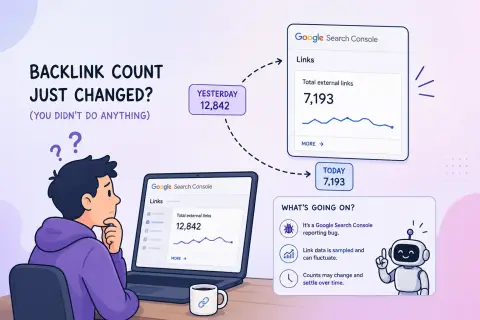
That's a materially different mechanism from the Google Search Console links-report bug already covered on this blog. That piece was about a temporary reporting glitch in an existing report that briefly showed inaccurate backlink counts. This is a permanent, new property type measuring something GSC never measured before: search demand for content a brand doesn't host on its own domain.
What to actually do with it
Connect every active social account now rather than waiting for a specific question that needs answering. With no backfill, an unconnected account isn't neutral, it's a growing gap in data that can't be recovered later. Once connected, treat the early numbers as directional rather than definitive; Google's own July 7 announcement described the rollout as gradual, and coverage still varies by platform and content type while it matures. Before commissioning new content, check whether a query already has an answer living on a verified social account, and before greenlighting a creator partnership, ask whether the brief can be written against a specific query gap instead of a follower count.
None of this replaces earned coverage or a vetted directory listing as ways to build real authority beyond a brand's own site. What it adds is a way to know, with actual first-party evidence, which of those efforts is worth pointing at which conversation before spending the budget to find out the hard way.