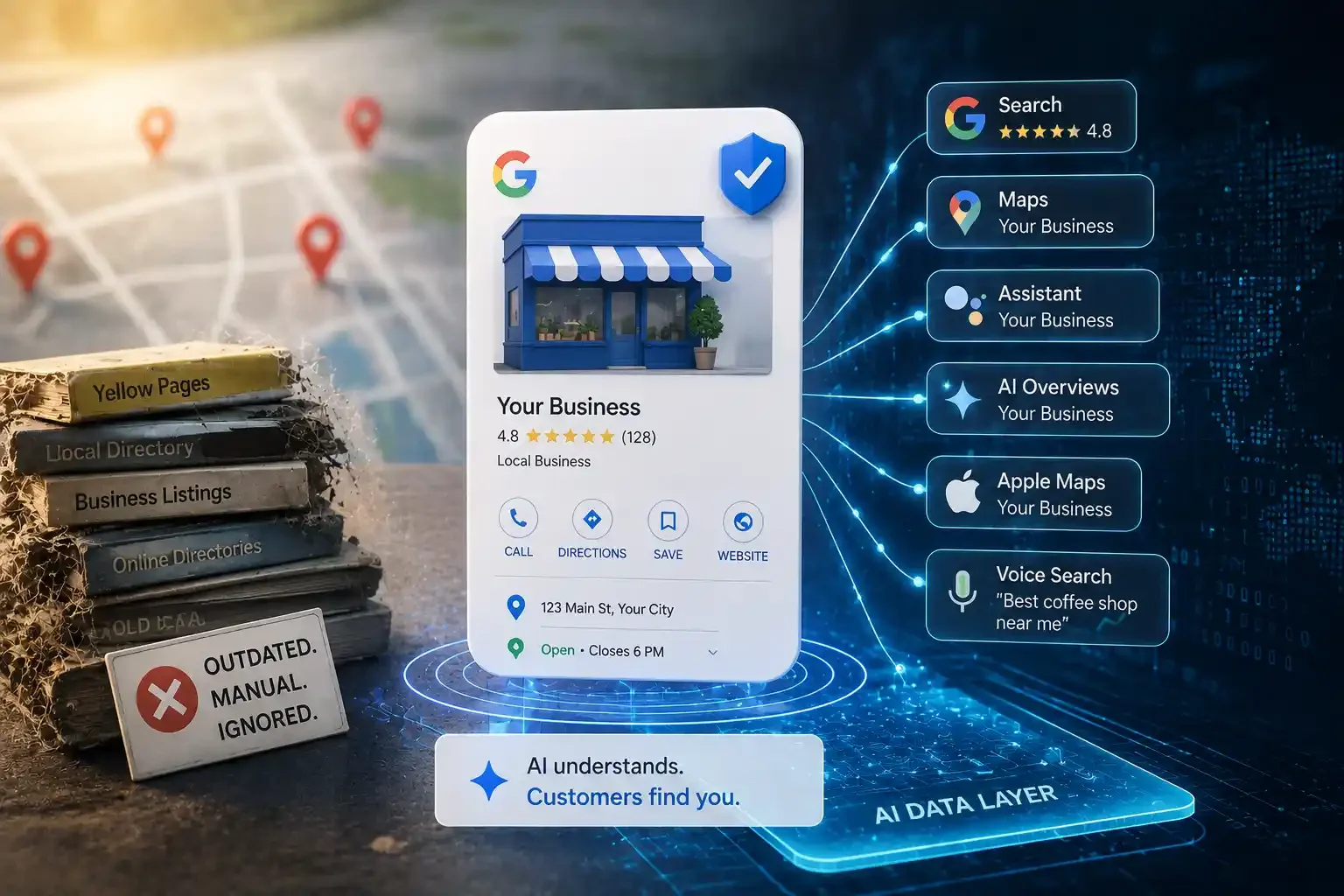
The old checklist was 30 directory listings and hope. Now one profile grounds Gemini and AI Overviews, and a few platforms decide who AI recommends.
The old local-citation playbook was a checklist: get your business listed on 20 or 30 directories, keep the name/address/phone consistent, wait for the trust signal to accumulate. That checklist still isn't wrong, exactly. But it's now solving the wrong problem. The real shift in 2026 is that a customer asking an AI assistant "best plumber near me" increasingly never sees a ranked list of websites at all. They see one answer, and that answer comes from a small, measurably lopsided set of sources.
The click is disappearing, and local search feels it most
A SparkToro analysis of Similarweb data found that 68% of U.S. Google searches ended without a click in early 2026, up from roughly 60% in 2024. That's already a big number, but it understates what's happening in AI-mediated searches specifically. When a Google AI Overview appears, 83% of searches generate no click to any external site, according to HousingWire's reporting on the SparkToro data. In Google's dedicated AI Mode, that figure reaches 93%. Google said at its 2026 I/O conference that AI Mode had passed one billion monthly users, with query volume more than doubling quarter over quarter.
That's not a marginal shift in how people search. It's a description of an environment where the AI's chosen answer functionally is the search result, and there's no second-place website getting the leftover clicks.
Why Google Business Profile specifically
Google's "Grounding with Google Maps" capability, connecting its models to more than 250 million verified places, reached general availability in 2026. When Gemini or AI Overviews answer a location-based query, they treat the Business Profile as the authoritative source, not a website's own claims about itself. That's a different relationship than the old SEO one, where a business's website was the primary asset and directories were supporting signals pointing back at it. Now the profile itself is the primary data feed, and the website is one of several things the AI cross-references against it.
Birdeye's State of Google Business Profile 2026 report, based on an analysis of large multi-location brands across 30+ industries, backs this up with real numbers. Verification is now the baseline: 76% of profiles were verified in 2025, up from 71% in 2024, and verified profiles get up to 4x more website visits along with double-digit increases in calls and direction requests. Impressions per location dropped 53.8% as AI answers absorb more queries directly, but customer actions, the calls and direction requests that actually matter, fell by only about 5%. Fewer people see the listing; the ones who do are more qualified. And 86% of GBP impressions now come from category searches like "plumber near me" rather than branded searches for a specific business name, which means showing up correctly for the category is the whole game, not brand recognition.
The citation leaderboard is real, and it's not close
Outside of Google's own AI Overviews and Gemini, the question becomes which third-party local platforms actually get cited when ChatGPT, Perplexity, or Google AI Mode answer a "best X near me" question. A Foundation Marketing and AirOps analysis of over 28 million AI responses, covering Q4 2025 across ChatGPT, Gemini, Perplexity, and Google AI Mode, tracked citation volume for six major local discovery platforms: Yelp, the Better Business Bureau, Angi, Thumbtack, HomeAdvisor, and NextDoor.
Yelp got 512,680 citations in that quarter, more than the other five platforms combined. BBB came second at 149,710, then Angi at 145,633, Thumbtack at 56,004, HomeAdvisor at 33,582, and NextDoor at 10,308. Yelp's lead is even more pronounced on "near me" queries specifically: it generated roughly 290,000 near-me citations across platforms, versus about 87,000 for all five competitors combined.
The distribution isn't even across platforms, though, which matters if a business is trying to figure out where to invest effort. Google AI Mode and Perplexity together account for 95% of the total citation volume in this study, and Yelp dominates both of those specifically. But on ChatGPT, BBB actually leads with 68,617 citations to Yelp's 25,681, and on Gemini, Angi leads while Yelp barely registers. A business optimizing only for Yelp because it wins the aggregate number could still be invisible on the one platform where a different competitor happens to lead.
One scope note worth flagging: this particular study's competitive set was limited to those six platforms and explicitly excluded Google Maps and TripAdvisor, so it's measuring the citation fight among directory-style local platforms specifically, not GBP's own separate role as the grounding source for Gemini and AI Overviews described above. Those are two different layers of the same system.
Old-style breadth still does something, just not the same thing
It would be a clean story to say only six platforms matter now and the rest of the citation ecosystem is dead. That's not quite accurate either. Yext's own testing of what AI models say when asked directly where they source local business data turned up a long tail well beyond the big names, smaller directories like Hotfrog, CitySearch, MerchantCircle, and Superpages showed up repeatedly across ChatGPT, Bing Copilot, and Meta AI's self-reported source lists. That testing is a couple of years old at this point and AI sourcing behavior moves fast, so treat the specific site list as illustrative rather than current, but the underlying mechanism is still plausible: even directories that never win a visible citation can still function as a consistency check, one more place confirming the same name, address, and phone number match everywhere else.
That reframes what "local citation" work should look like now. Getting listed everywhere for its own sake was always a weak tactic; getting listed accurately everywhere, so nothing contradicts your Google Business Profile, is closer to what's happening under the hood. The citation leaderboard tells you where to fight for visibility. Broad, accurate NAP consistency is closer to table stakes that keep the leaderboard trusting your data at all.
What this changes about the work
Directory submission as a volume tactic, get listed on as many sites as possible, was never going to survive this shift, and it shouldn't. What replaces it is narrower and more specific: verify and fully complete the Google Business Profile first, since it's the one asset directly grounding Gemini and AI Overviews rather than just contributing a signal. Pick the correct category over keyword-stuffed descriptions, since 86% of impressions are category-driven, not branded. Then, separately, invest specifically in Yelp for near-me and category queries given its citation dominance on AI Mode and Perplexity, while checking whether BBB or Angi matter more for a specific vertical, since the leaderboard isn't uniform across platforms. Everything else, the smaller directories, exists to keep the data consistent underneath those two priorities, not to be a citation-building campaign in its own right.