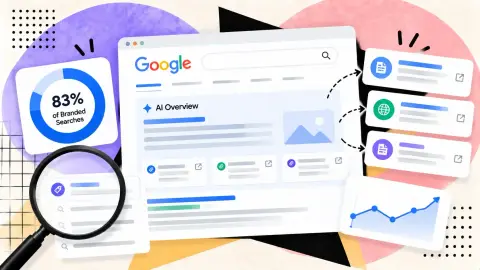
Before you repeat an AI ranking factor score, check the source page, scale, sample and outcome. Five checks, using the backlink 1.9 claim as an example.
An AI ranking factor claim can reach you as a single chart and a headline number. Before you change your plans or repeat the number, run five checks on the study page itself. Here is how, using two real examples: one page that gives you scores without a method, and one study that publishes its method.
Find the original page
Start with the page the number came from, not the post that quoted it. A blog post from August 2026 at a marketing agency says: "In an analysis of over 80 ranking factors across AI platforms, NP Digital found that backlink profiles scored a modest 1.9 out of 5 in determining whether an AI engine recommends a brand." It does not link to NP Digital.
The closest NP Digital page we found is What Influences ChatGPT Recommendations, dated December 2024. It describes an "NP Digital study analyzing 82 ranking factors for ChatGPT recommendations." Its text lists four scores: relevancy at 0.91, brand mentions at 0.87, reviews at 0.61 and authority at 0.52. It names age and recommendations as the weakest signals. The page text does not mention backlinks or a 1.9 score, and it says ChatGPT, not AI platforms in general.
Compared with this page, the quote differs in three ways: one platform became all AI platforms, 82 factors became over 80, and a score appears that the page text does not show. A chart on the page may hold more rows. Until the source shows the figure, treat it as unconfirmed.
Ask what the score measures
A score means nothing without its scale. The NP Digital page calls reviews a "weighted influence" but does not say what the weights are, what the top of the scale is, or how the score was produced. That is why a 1.9 out of 5 cannot be compared with an authority score of 0.52 from the same page. They may not even be the same kind of number.
Compare the Ahrefs study of AI Overview brand visibility, published May 26, 2025. It states the method plainly: "We used the Spearman correlation coefficient to analyze the data in this study". Now you know each number is a rank correlation, where higher means a stronger relationship and nothing more.
Look at the sample and the filters
Who was measured decides who the result applies to. The Ahrefs study covers 75,000 brands, and it explains how it picked them: "We filtered for domains with DR > 40 and took their highest volume keyword with a monthly search volume of at least 800." It also says "Roughly 26% had zero mentions" and that it studied the rest.
That tells you the results describe established brands that already get some AI Overview mentions. A new site with few links is outside that sample. The NP Digital page gives no sample size, no prompt count, no ChatGPT version and no collection dates, so you cannot tell whom its scores describe.
Separate correlation from cause
Studies like these measure what tends to appear together, not what causes what. Ahrefs says this itself in the same study and calls all the factors it found moderate to very weak correlations on the Spearman scale. In its data, branded web mentions correlated at 0.664 and the number of backlinks at 0.218.
Our view: that is useful evidence that brand presence travels with AI Overview mentions, and that raw link counts are a weaker signal for this outcome. It is not proof that backlinks do not matter. Mentions and links can come from the same coverage, so the two are hard to pull apart.
Match the outcome to your question
Each study measures one outcome on one platform. NP Digital says ChatGPT recommendations. Ahrefs measured brand mentions in Google AI Overviews. Neither page says it measured classic Google rankings or citations with a link. If your question is whether links help you rank on Google, these studies do not answer it.
Our post on why most ChatGPT citations come from classic search rankings covers a different outcome, and backlinks versus brand mentions in AI citations covers a correlation study with its own filters. Read them as separate pieces of a picture, not as one ranking.
A quick scorecard
Before you cite an AI ranking factor number, you should be able to answer yes to each of these:
- I opened the study page itself, not a post quoting it.
- The page says what the score measures and on what scale.
- The page gives the sample, the filters and the dates.
- I am describing a correlation as a correlation.
- The outcome and platform match the claim I am making.
If the answer to the first two is no, do not repeat the number. If you want to know how AI tools see your own site rather than an average across thousands of brands, SerpCrest's AI Search Readiness Audit checks whether ChatGPT, Perplexity, Claude and AI Overviews can read and cite it.