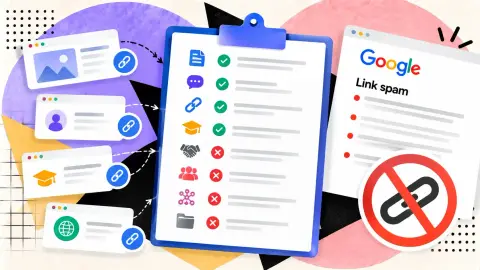
Google's helpful content page now calls fabricated author profiles deception. Here is the exact wording and what it doesn't say about guest post links.
On October 2, Search Engine Journal reported that Google's page on creating helpful, reliable, people-first content had picked up a new warning about fake authors. The page shows a last-updated date of October 1, 2026. The new text sits in the "Who" section, directly after Google's advice to add accurate bylines.
Here is the paragraph, as it reads on Google's page: "However, avoid using deceptive authorship information. Fabricating creator profiles (such as by using AI-generated headshots, made-up names, or false credentials to make content appear as if it was written by human experts) is a form of deception. Any form of deception makes a page untrustworthy to both users and our automated quality systems, and is a signal of a low-quality page."
Link builders have already started reading that as a verdict on guest post farms and link marketplaces, many of which publish under invented bylines with generated headshots. The reading is tempting. It also goes further than the text does.
What changed, and what didn't
Search Engine Journal's report by Matt Southern makes two points worth keeping. First, the idea isn't new. Google's quality rater guidelines already told raters to treat fabricated creator profiles, AI-generated author images and false claims of expertise as deception. What changed on October 1 is that the same idea now appears in guidance written for site owners. Second, the new paragraph doesn't say how Google's automated systems would spot a fabricated profile, and no ranking update was announced alongside it.
Google's own page also says that raters "have no control over how pages rank" and that rater data isn't used directly in ranking algorithms. So the rater guidelines are a statement of what Google wants to reward, not a description of a detector. The new paragraph is a stated principle with no published mechanism behind it.
Why this isn't a link policy
The paragraph appears on a page about content quality. It talks about pages becoming "untrustworthy" and being "a signal of a low-quality page." It doesn't mention links, link equity, or what happens to a link that sits on a page with a fabricated author.
Google's rules for links live somewhere else. Its spam policies, last updated August 28, 2026, list "buying or selling links for ranking purposes" under link spam, and separately name "links with optimized anchor text in articles, guest posts, or press releases distributed on other sites." Those policies are why a paid guest post is a problem. A fake byline is a second, separate problem sitting on top of it.
That distinction changes what you should do with this news. If you buy guest posts, the new paragraph doesn't create a new risk for your own site's links. What it does is put a clearer label on a pattern that already marked a placement as low quality.
The practical read for link buyers
Fake authorship is a useful screening signal, even without a confirmed penalty, because it tends to travel with other editorial shortcuts. A publisher that invents contributors may not be editing what it publishes either, though that's an inference, not something Google says. Before you pay for a placement, check four things.
Search for the author's name and photo. A byline with no footprint outside the site, or a headshot that reverse-image-searches to a stock library or nothing at all, tells you the publisher either doesn't care or doesn't know. Look at whether the site's other authors share the same backdrop, lighting and framing, which can point to generated or stock images. Check whether the author's claimed credentials can be verified anywhere independent. And look at the site's topic range: one "author" writing authoritatively on dentistry, crypto and kitchen remodeling in the same month is a pattern, not a polymath.
Our guides on vetting a backlink placement before you pay and on what "vetted" means at AI-powered link marketplaces cover the wider checklist. Authorship is one more line on it.
The practical read for publishers and guest authors
If you run a site that accepts contributions, the risk is nearer to home. Making up a persona to fill an editorial calendar, or letting a contributor use a fake name, is exactly what the paragraph describes. Real bylines with real, checkable bios cost you nothing and match what Google says it wants. If a contributor wants to stay anonymous, a plain "staff" byline is more honest than an invented person.
If you write guest posts yourself, use your own name and a bio that links to somewhere you can be found, such as a company page or a professional profile. Our post on what gets a guest pitch accepted now covers the editor's side of that.
What to leave alone
Don't rip out every byline you can't verify across a large site on the strength of one paragraph. Google has not said that fabricated authors trigger a demotion, a manual action, or an algorithmic filter, and it hasn't said how it would tell. Southern also notes that Google's Search Liaison account said in January 2024 that bylines don't help pages rank. The accurate summary is narrower than the headlines: Google now says in plain words that invented authors are deception, and treats deception as a low-quality signal, with no stated consequence beyond that.
If you audit one thing this week, make it your own site. Open your author pages, confirm each name belongs to a real person who agreed to be listed, and replace any generated photos. Then apply the same four checks to any site you're paying for a link.